
· Medical Devices · cityboat
Rethinking the Cost of Single-Use Endoscopes
From the manufacturing of flexible urology scopes to clinical trade-offs in orthopaedics
 --views
SI creation: Single-use endoscopes
Volume-based procurement and product information for single-use flexible urology scopes offer a useful reference for orthopaedic endoscopy. For hospitals and device developers, the central question is whether reliable products and services can be delivered sustainably within the limits reflected by awarded prices.
This note uses flexible urology scopes as a research example, examining manufacturing costs and commercial models before turning to the clinical choices facing orthopaedic customers. It considers a single-use pathway from access tools to therapeutic instruments, along with the policy and commercial conditions for day surgery. The ultimate measure is not the lowest price of a scope, but demonstrable value across a clinical episode.
Cost reduction should remove complexity without clinical value while preserving the field of view, dimensions and reliability that the procedure requires.
Procurement Prices and Manufacturing Costs
On 28 January 2026, China's national joint procurement office for high-value medical consumables announced the award results for drug-coated balloons and urological interventional consumables. Participating regions were instructed to implement the results in May, with specific dates set locally. The focus here is the single-use flexible ureteroscope catheter category, not all urological endoscopes, and not guidewires, access sheaths or complete stone-treatment consumable sets.
Examples of awarded prices for single-use flexible ureteroscope catheters in early 2026 included RMB 647 for Surgsci, RMB 650 for Puyue Medical and RMB 697 for Vathin Medical. All were in the category without physiological pressure measurement at the target site.
| Company | Awarded Price |
|---|---|
| Surgsci | RMB 647 per scope |
| Puyue Medical | RMB 650 per scope |
| Vathin Medical | RMB 697 per scope |
These figures indicate transaction boundaries for specific products, not manufacturers' underlying costs. Without historical transaction prices for the same model, configuration and service package, a striking percentage price reduction would be misleading. Products with and without pressure measurement should also be analysed separately, not combined into an average price.
A procurement award must also be distinguished from insurance coverage. Shanghai's 2026 implementation annex, for example, listed single-use flexible ureteroscope catheters both with and without pressure measurement as not covered. This was a local provision, not a nationwide rule. It nevertheless illustrates three separate questions: entry into a procurement catalogue, a hospital's willingness to use the product, and how the patient pays.
Four Perspectives on Cost
Customers need to distinguish different layers of cost. R&D focuses on the bill of materials, procurement on transaction terms, finance on business sustainability, and clinicians on per-case expense and performance. A price discussion is meaningful only when the boundaries of comparison are consistent.
| Perspective | Question to Answer |
|---|---|
| Materials | What does it cost to buy or make the sensor, lenses, illumination, cables, bending section, tubing and handle? |
| Manufacturing | After assembly, inspection, sterilisation and packaging, what has each conforming released scope actually consumed? |
| Business | Is the business sustainable after channel costs, console support, after-sales service, inventory, working capital and continuing R&D? |
| Clinical Use | For the same type of procedure, what does the hospital spend on the scope, supporting equipment, turnaround and failures? |
An awarded price is not the manufacturer's revenue excluding tax, and that revenue is not the budget available for manufacturing. Direct sales, distributors, console sales and console placement all change cash flows and responsibilities. Comparisons must use a consistent tax basis and avoid charging the manufacturer again for distribution already borne by a dealer, or deducting console support already included in the quotation.
Consider a purely illustrative budget: end-customer revenue excluding tax is 100 units; commercial fulfilment and non-manufacturing inputs take 35; and 15 must remain for target profit and a risk buffer. Only 50 is then available for manufacturing conforming products. The figures 100, 35 and 15 are assumptions, not any manufacturer's disclosed costs. They show that different commercial models can support different manufacturing costs even at the same selling price.
A price slightly above RMB 600 therefore cannot reveal the manufacturer's cost. A more useful approach works backwards from verifiable net revenue, then checks quotations for matching specifications, process data and actual yields. Procurement award information alone does not contain the internal data needed for that calculation.
Breaking Down Flexible Ureteroscope Manufacturing
A single-use flexible ureteroscope is not simply a camera attached to a plastic tube. The manufacturing cost of a basic deflectable scope can be divided into seven units. The two simplified illustrations show external modules and illumination paths. Model-specific pressure sensing, suction and other functions are additional; the diagrams do not represent any company's actual internal design.
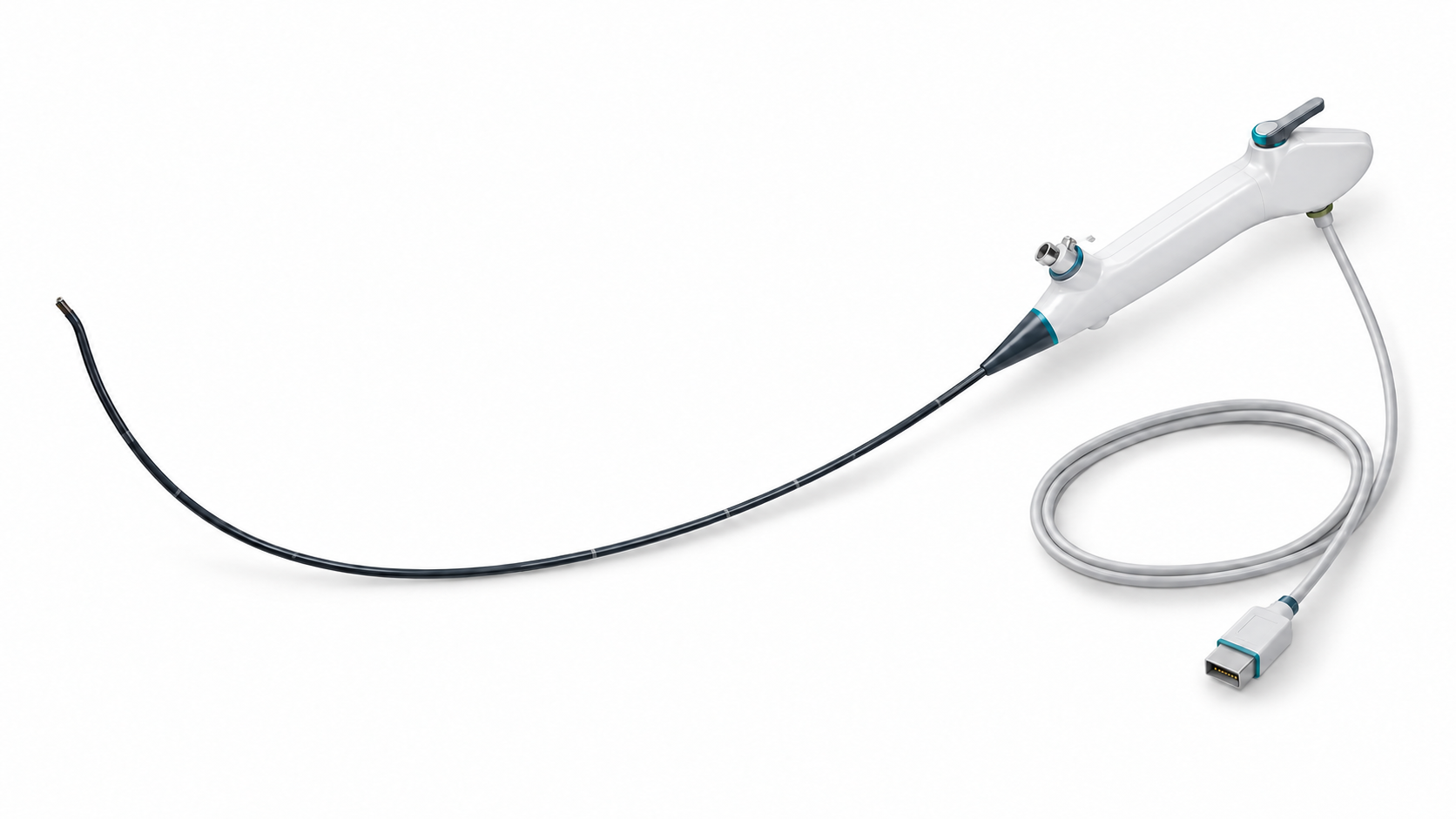 Distal tipBending sectionInsertion tubeControl handle and instrument inletCable and connector
The scope comprises a distal tip, bending section and insertion tube, connected proximally to the control handle, instrument inlet and cable.
The Imaging Chain: Buying a Stable Image, Not Just a CMOS Sensor
First establish what the supplier actually delivers: a bare sensor, a miniature module with optics, a camera assembly with cable, or a complete imaging chain with proximal electronics and image tuning. For example, OMNIVISION's OCHTA10 and OCHFA10 are camera modules with integrated optics, whereas OV9734 and OV6946 are image sensors requiring separate lenses and packaging. Their scopes of supply differ, so their bare unit prices cannot be ranked directly.
The cost breakdown needs to cover sensor and optics, illumination, flexible circuits and cables, connectors, proximal interfaces, focusing and image-consistency testing. With an integrated-optics module, do not count processes already covered by the quotation twice. With a sensor, add lenses, packaging and system integration. A cheaper sensor may not make the complete scope cheaper if it requires more complex long-distance signal transmission, a larger package or additional tuning.
The priority is to standardise the field of view, depth of field, colour and detail recognition actually needed, remove specifications without clinical use, and then compare the cost of a complete, conforming imaging chain. When dimensions, optics, illumination, cables or quotation scope change together, the entire price difference cannot be attributed to a chip substitution.
Imaging quotations should identify the complete part number, suffix and scope of supply. If purchasing documents use TA10 or FA10 as shorthand, confirm whether they mean OMNIVISION's OCHTA10 or OCHFA10. Specify module dimensions, whether lenses and cables are included, cable length, connectors, factory test conditions and responsibility for image tuning. Fibre illumination also requires the fibre bundle, coupling, end-face processing and transmission-consistency checks. Distal LEDs instead require miniature light sources, electrical connections, packaging and thermal validation. Work included in a complete module must not be charged again as final-scope assembly.
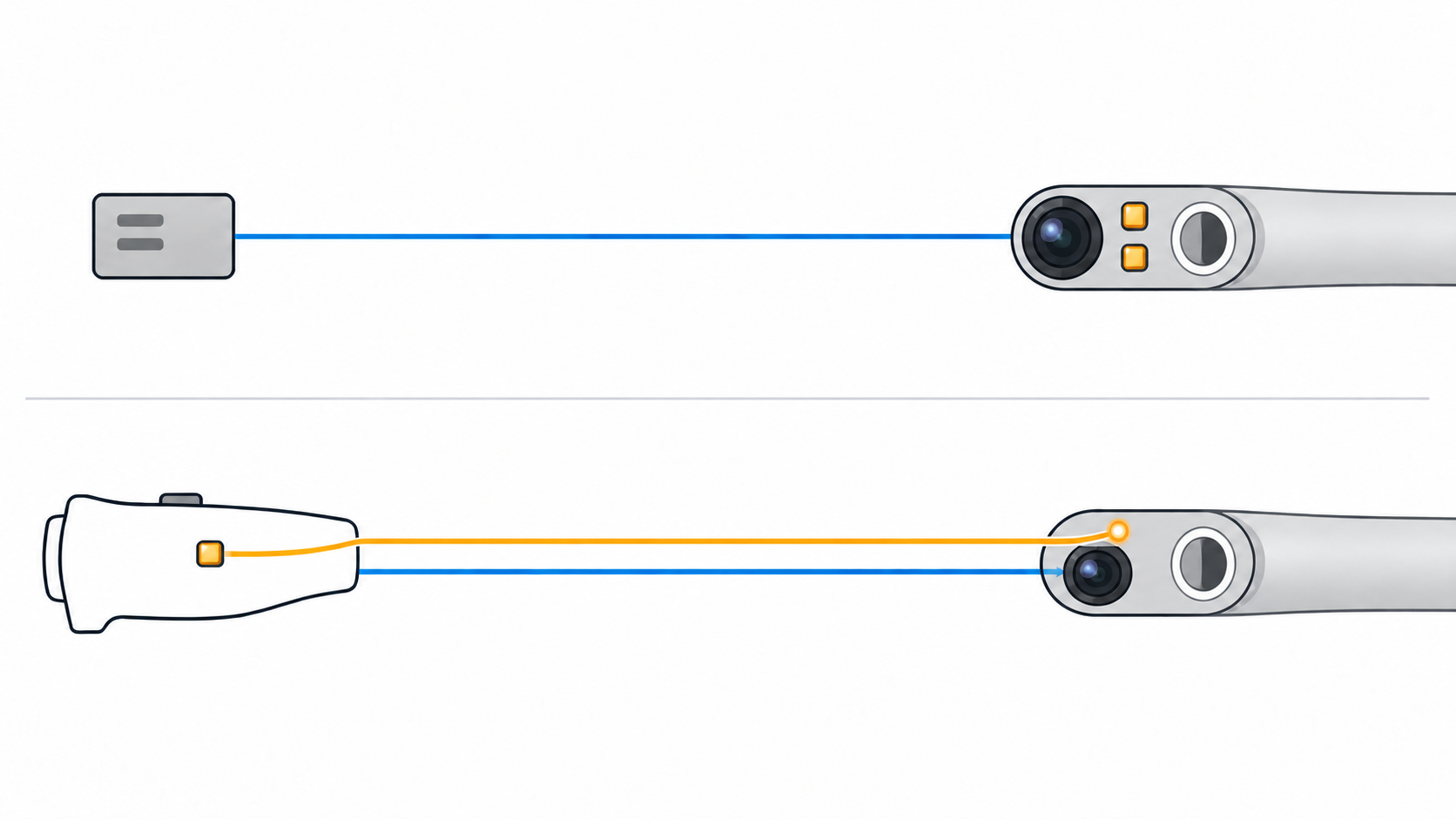 Direct Distal LED IlluminationProximal LED with fibre light deliveryElectrical control moduleElectrical connectionDistal LEDsCameraWorking channelLED in the handleIllumination fibreLight outletCameraWorking channel
Top: direct illumination by distal LEDs. Bottom: light from a handle LED travels through a fibre. The camera connects electrically; the working channel carries instruments and fluid.
The Bending Section: Assembly and Consistency Beyond Part Prices
The bending section needs its own account: support structure, pull wires, attachment points, outer covering, assembly labour, tension adjustment and deflection testing. Omitting any item understates cost. Metal articulation structures, cut structures, riveted structures and polymer designs can be compared as manufacturing routes, but material prices per kilogram cannot determine the choice alone.
Customers should ask whether the expected deflection remains possible with an instrument inserted, whether operating force is consistent, whether return to the neutral position is reliable, and whether batch variation is controlled. Fewer parts, easier pull-wire positioning and measurable process settings in place of manual adjustment often deserve more investment than simply downgrading materials.
Part yield and assembly yield must be separated. A poor pull-wire attachment may waste one process step; a deflection fault discovered after sealing may scrap the entire expensive distal assembly. Record acceptance rates for machined parts, threading and fastening time, tension-adjustment cycles, and performance pass rates with instruments inserted.
Insertion Tube and Working Channel: Less Space Can Mean Harder Manufacturing
This unit includes tubing, lining, necessary reinforcement, surface treatment, the transition to the bending section and all seals. Wall thickness, channel size and outer diameter are not independent figures. Making the scope thinner while retaining instrument passage and fluid exchange reallocates dimensions and tolerances throughout the structure.
For device developers, quotations need to cover tube processing, assembly, instrument passage and irrigation or suction performance, rather than treating tubing as a generic accessory. Standardising specifications, improving length utilisation, reducing joints and stabilising processing are useful starting points. Any thinning, material substitution or coating change requires renewed assessment of kink resistance, friction, sealing and relevant safety performance.
A 2025 bench study of direct-in-scope suction compared different channel dimensions, deflection angles and the presence or absence of instruments. Suction efficiency varied with these conditions. This supports evaluating channels in realistic operating states. It is engineering evidence, not direct proof of higher clinical stone-clearance rates or lower infection rates.
Handle, Cable and Connections: Small Costs, Accumulating Complexity
Injection-moulded parts, rotating and stop mechanisms, fasteners, strain relief, cables and connectors should be costed separately. An additional variant means more than another part number: it may also require tooling, fixtures, material stocks, inspection and inventory.
The direction is to eliminate unnecessary parts, standardise compatible interfaces, improve moulds and assembly location features, and retain durable processing capability in reusable equipment. But putting fewer components in the disposable end is not an unconditional rule: the sterile boundary, cleaning and maintenance, electrical safety and cable transmission must all remain adequate.
Moulded-part quotations should state whether tooling is charged separately, its expected life and the amortisation volume. Cable quotations should identify shielding, length and termination. Fluid connectors, operating mechanisms and optical or electrical components are different functional chains; sharing a housing does not justify combining them into an uninformative handle-cost total.
Assembly and Testing: Labour Hidden in Module Quotations
Threading, fastening, focusing, adhesive dispensing, curing, sealing, deflection adjustment and final inspection should each have associated labour time, equipment occupancy and first-pass yield. A purchasing sheet containing only a module total gives little indication of whether the expense comes from parts, tuning, rework or poor yield.
Manufacturing reviews should identify manual adjustments that locating features could replace, repeat rework that process monitoring could prevent, and screening that should occur before packaging. The later an expensive component fails inspection, the harder it becomes to recover the tubing, labour and packaging already added. Cost reduction should make defects visible earlier, not make them easier to pass through final inspection.
Separate active operation from waiting. Adhesive dispensing may be brief while curing occupies fixtures and work in progress. Leak-test equipment may be shared by several operators; its entire waiting time must not be allocated repeatedly to every scope. Recording productive labour, equipment cycle time and rework separately reveals whether to redesign parts, add fixtures or reorganise production.
Sterilisation and Packaging: More Than a Final Processing Charge
There are three layers: packaging consumed per unit; batch-level sterilisation, sampling and release; and process or shelf-life validation during development and changes. Ethylene oxide processing involves more than a chamber price. Residuals, aeration time, material compatibility and post-sterilisation imaging, deflection and sealing performance all matter. The sterile barrier must also withstand transport and shelf-life conditions. FDA sterilisation guidance expressly addresses residuals, process validation, packaging integrity and ageing information.
Packaging structure, loading efficiency, batch organisation and turnaround time can be improved. Unvalidated shorter cycles, reduced packaging protection or omitted critical inspections are not cost-reduction achievements. Less waiting can release working capital; weaker validation increases risk.
Allocate unit packaging materials, batch sterilisation fees, sampling and release, aeration space and inventory separately. Small batches can increase the per-unit share of fixed testing and logistics. Oversized packaging can reduce loading efficiency and raise transport costs. These factors must be considered alongside sterile-barrier performance, not reduced to a supplier's unit sterilisation fee.
Pressure Sensing and Suction: Account for Added Functions Separately
A pressure-sensing scope is not simply a standard scope with one extra sensor. Its incremental cost includes packaging and sealing, calibration, cables and interfaces, software display and applicable validation. Boston Scientific presents intrarenal pressure monitoring as a system feature of LithoVue Elite, not an isolated part unrelated to the console.
Suction similarly needs to be considered together with flow paths, valves, blockage handling and instrument occupancy. Basic and enhanced models are reasonable, but price tiers should reflect performance and evidence rather than a different name. Procurement examples for basic models cannot be treated directly as cost ceilings for enhanced models.
Five types of input can bring the seven units into a common costing sheet. These are ways for customers and suppliers to establish costs, not industry averages or judgements about any supplier's prices.
| Cost Layer | Suggested Input | Avoid Omissions and Double Counting |
|---|---|---|
| Materials and Purchased Assemblies | Actual quantity consumed × unit price on the same basis | State whether tax is included; identify processes already included in the module |
| Direct Assembly and Rework | Productive labour time × applicable labour rate | Separate labour rates from overhead; do not add a second loss allowance for rework |
| Equipment and In-Process Inspection | Workstation occupancy, inspection cycle and actual allocation | Distinguish operation, curing, waiting and shared equipment |
| Sterilisation, Packaging and Release | Unit materials + allocated batch charges | Use the conforming released quantity of the corresponding batch as denominator |
| Dedicated Tooling and Validation | Separate investment and amortisation scenarios | Identify costs already quoted; do not treat forecast volume as actual sales |
How Yield and Volume Affect Conforming Unit Cost
Combining these inputs gives the following calculation:
Manufacturing cost per conforming unit = net actual production-related batch expenditure ÷ quantity released as conforming
The numerator includes materials, labour, manufacturing overhead, inspection, sterilisation and packaging actually consumed by the batch, less recoverable residual value. Rework and scrap already affect consumption and the denominator; do not add another generic loss percentage. Channel costs, console support and R&D belong in a separate business-level calculation.
Consider an example intended only to explain the mechanism: each item entering a process incurs 100 cost units before inspection, with no rework or residual value. If final yield rises from 90% to 98%, that process's cost per conforming item falls from 111.1 to 102.0, about 8.2%. This does not mean the whole scope necessarily becomes 8.2% cheaper. It shows that yield improvement can create value without reducing material prices.
Volume calculations also need the right denominator. If a fixed validation expenditure is unchanged but actual saleable output is half the plan, its allocation per unit doubles. The same logic applies to console placement: identical expenditure spreads differently across different numbers of paid cases. Procurement awards, nominal capacity, released units, units sold and units paid for are not the same number.
Economies of scale should therefore be separated into purchasing leverage, production cycle time, yield improvement and fixed-cost allocation. Higher volume may improve some of these, but may also increase inventory and financing pressure. Contracted procurement quantities can inform planning; unfulfilled future demand is not an accomplished fact.
International Commercial Approaches and China's Procurement System
Public commercial information from international leaders illustrates how consumables enter institutional purchasing and clinical workflows. Ambu places cystoscopes, cysto-nephroscopes and ureteroscopes within a portfolio using a shared display and processing platform. Its cystoscopy budget-impact tool brings cleaning, repair and the institution's own per-case costs into purchasing discussions. Shared platforms and costing support may reduce the organisational burden of adopting single-use systems, but benefits depend on installed equipment and case mix. Cystoscopy economics cannot simply be transferred to ureteroscopy.
Boston Scientific's approach is more closely linked to a stone-treatment portfolio. LithoVue Elite differentiates through imaging, intrarenal pressure measurement and integration with the StoneSmart console; combination ordering options with the Empower stone-retrieval assist device are also listed. Commercial comparisons can therefore consider functions across a treatment episode, but this does not establish actual hospital discounts, rebates or mandatory bundles in different countries. Console purchase, leasing or placement linked to consumable volumes must be checked in contracts. Free placement is not a universal industry model.
Payment opportunities can also expire. Single-use urological endoscopes under the US C1747 code previously qualified for transitional additional payment, but CMS specified that this status ended on 31 December 2025. From 2026, the code remains valid while payment under OPPS is packaged into the primary service. Older supplier pages must not be treated as evidence of a permanent premium, still less as a revenue assumption for a Chinese business model.
In China, the first task is to turn an awarded price into a sustainable delivered price. Align regulatory and procurement categories, configurations, distribution and console-support responsibilities; allocate investment over actual fulfilled volume; and account for receivables and inventory. Product tiers need clinical justification. The National Healthcare Security Administration's explanation of the sixth procurement round described comparison coefficients for certain innovations according to clinical value, and pressure-sensing ureteroscope suppliers also won awards. Differentiation must be recognised by rules and evidence, not merely by a new product name.
Purchasers need reliability, yield and dependable supply from basic models. Pressure sensing, suction and other enhancements need evidence of incremental value in relevant cases, as well as clarity on procurement and payment boundaries. A low-price scope with expensive mandatory accessories must not recreate the original per-case expense. Overseas charges and bundles cannot simply be imported into China. Shared platforms, workflow support and whole-case costing are useful lessons; unverified contract terms are not.
Orthopaedic Illumination Is Not Just a Parts-Price Decision
Start with the terminology: an LED is a light source; fibre is a light-transmission medium. The supposed LED-versus-fibre choice is really distal LED illumination versus light delivered from a proximal source through fibre. That proximal source can itself be an LED. Electronic-sensor imaging versus a rod-lens system is a separate design choice.
| Product | Illumination Architecture |
|---|---|
| Boston Scientific LithoVue and LithoVue Elite Single-use flexible ureteroscope | LithoVue has its light source in the handle. Elite uses a handle LED with fibre light delivery; the distal CMOS sensor outputs an electrical signal. |
| Ambu aScope 5 Uretero Single-use flexible ureteroscope | The distal tip contains a camera and two LEDs, providing direct distal illumination. |
| Arthrex NanoScope Miniature electronic endoscope | LED light travels through a fibre bundle to the area around the image sensor. Shaft diameter is 1.9 mm; the sheath adds to the access diameter. |
| HydroCision SpineSite Single-use electronic spinal endoscope | Distal LEDs surround the video sensor, with a total scope outer diameter of 5.0 mm. This example does not demonstrate that the same architecture can be reduced to 2.0 mm. |
Both routes have valid applications and need engineering comparison in the context of structure and validation responsibilities.
| Dimension | Proximal Source with Fibre Light Delivery | Direct Distal LED Illumination |
|---|---|---|
| Cost Drivers | Fibre bundle, end-face processing, coupling alignment and transmission checks; light source and console considered separately | Miniature LEDs, circuits and soldering, optical packaging, sealing, thermal management and testing |
| Structural Strengths | Moves the light source and most of its electrical power dissipation away from the tip; permits small light-delivery cross-sections | Can eliminate long fibres and coupling steps; suits structures with adequate packaging and thermal headroom |
| Main Constraints | Optical losses, broken fibres, bending and assembly yield; the light outlet still needs thermal validation | Distal light sources, electrical connections and heat management occupy space; miniaturisation can increase assembly costs |
| Image and Reliability | Check actual output, uniformity and mechanical effects, not just the source's rated brightness | Check working distance, uniformity, glare and temperature rise, not just whether a clear image appears when powered |
| Economic Assessment | Fibres and coupling may cost more, but total cost and clinical usability need comparison at equivalent specifications | Some materials and process steps may be cheaper, without guaranteeing a cheaper system or lower cost per case |
Comparisons must hold field of view, viewing direction, working distance, usable image quality and reliability requirements constant. Test normal irrigation, low flow and, where applicable, interrupted flow. Fibre does not mean no heat, and LEDs are not inherently low-cost. Validation conditions must follow the intended use and risk analysis.
What a 2 mm Requirement Costs
When a clinician asks for 2.0 mm, first determine whether this means shaft diameter, maximum distal-tip diameter or the access diameter including a sheath. A circular 2.0 mm cross-section has a gross area of about 3.14 square millimetres; tube walls, insulation and seals reduce usable space. OCHTA10 and OCHFA10 module cross-sections are not directly equivalent to the OV6946 sensor-package cross-section, which still needs lenses and assembly packaging. Even a camera module narrower than 2 mm may not fit after illumination, wires and structure are added.
Miniature fibre illumination partly separates light-source placement from distal-tip space, preserving design room for imaging and mechanics. Its price may be finer fibre handling, coupling alignment, end-face processing and harder-to-control assembly yield. In a narrow joint or minimally invasive observation task, if these inputs deliver the required access dimensions and usable view, they are necessary costs imposed by clinical constraints, not simply expensive parts to eliminate.
For an orthopaedic project with a firm outer-diameter requirement around 2.0 mm, the design must also satisfy field of view, brightness, temperature rise, sealing and mechanical reliability. If available distal-LED designs cannot meet all these requirements and a fibre design has been validated, fibre may become necessary for that project. Higher fibre and assembly costs then purchase clinical usability. This conclusion depends on specific design boundaries; diameter alone cannot declare a universal winner.
Technical limits should also be described honestly. Research published in 2026 demonstrated an endoscope prototype with integrated microLEDs and an assembled maximum distal-tip diameter of 1.93 mm. It was tested on ex vivo porcine reproductive tissue, not validated for orthopaedic surgery, sterilisation reliability or production economics. A project's preference or need for fibre at 2 mm must not become a claim that every 2 mm endoscope can only use fibre. Component selection must also respect the space constraint; the specifications below help assess imaging and packaging headroom.
| Component | Supply Level | Selected Specifications | Orthopaedic Assessment Priorities |
|---|---|---|---|
| OCHTA10 | Integrated-optics camera module | 400×400 at 30 fps; module cross-section 0.65×0.65 mm; AntLinx analogue output. | Can preserve room for lighting and structure where space is very tight; required detail recognition still needs validation. |
| OCHFA10 | Integrated-optics camera module | 720×720 at 30 fps; module cross-section 1.15×1.15 mm; AntLinx analogue output. | A larger module cross-section buys more sampling points. Its value depends on the field of view, optics and packaging headroom. |
| OV6946 | Image sensor | 400×400 at 30 fps; sensor-package cross-section 0.95×0.94 mm; analogue output. | Requires separate lenses and packaging. Assess the complete camera assembly's size, assembly and consistency, rather than applying module quotations. |
| OV9734 | Image sensor | 1280×720 at 30 fps; single-lane MIPI, 10-bit RAW; lenses and system integration additional. | Public positioning includes notebooks and mobile devices. Medical designs require renewed validation of optics, long-cable transmission and suitability. |
Module and sensor dimensions in the table are neither finished scope diameters nor access diameters with a sheath. Pixel counts are not clinical image quality. With a circular field of view, a given working distance and irrigation conditions, optics, illumination, noise, latency and processing jointly determine visible detail. Compare the devices within the same clinical task and complete imaging chain, including assembly, testing and yield, rather than presuming that one component is always cheaper or more suitable for surgery.
Orthopaedic Expansion Means Different Clinical Tasks
Single-use arthroscopy can extend to the knee, hip, foot and ankle; visualisation systems can also serve spinal procedures such as UBE and synovial sampling in rheumatology. These are not identical indications or simple copies of one set of dimensions and instruments. Suitability for a procedure still depends on locally authorised use, instructions for use, compatible instruments and clinical evidence.
The Knee: From Observation to Meniscal Work
Cartilage, synovium, menisci and intercondylar structures require different viewing positions, directions and instrument arrangements. Technical reports describe needle arthroscopy assisting meniscal repair. A smaller viewing scope, however, does not mean that suturing, trimming and other therapeutic instruments or their working channels can shrink with it.
Product definitions should distinguish visual observation, sampling and tasks requiring sustained instrument manipulation. Those differences imply priorities in usable field of view, viewing angle, image stability after irrigation, scope control and instrument clearance. Smaller diameter alone is not a universal selling point.
The Hip: Reach and Viewing Angle Matter
Needle visualisation has been described as an aid to hip labral repair, but it does not remove the demands of deep-joint access, traction and instrument operation. Engineering specifications must therefore include working length, shaft rigidity, viewing angle and illumination. A short, thin scope suitable for a superficial narrow cavity is not automatically suitable for complex hip procedures.
Foot and Ankle: Where Miniaturisation Can Matter
The foot and ankle are not a single cavity. Anterior and posterior ankle regions, the subtalar joint, small joints and tendon sheaths impose different access and viewing requirements. Manufacturer materials describe several applications, and technical reports include office-based needle arthroscopy for anterior ankle impingement.
This helps explain why a scope around 2 mm can justify investment: the limit may be the space that can be entered, not a hospital's preferred diameter. Reaching the field is only the first step. Total size with a protective sheath, resistance to bending and damage, light distribution, instrument access and irrigation must all be considered. Paying for miniature light delivery and precision assembly has a clear product rationale under these conditions.
UBE: Spinal Visualisation Requires a Fresh Assessment
Unilateral biportal endoscopy, or UBE, separates viewing and working portals. An original technical report described a 30-degree arthroscope for decompression of lumbar spinal stenosis, showing how arthroscopic visualisation can serve a spinal field. That evidence did not validate a single-use 2 mm scope.
Spinal procedures involve bony obstruction, soft tissue and bleeding that affect visibility, as well as detail recognition near neural structures. Viewing direction, working length, illumination, image stability, irrigation and instrument movement therefore need fresh validation. UBE does not inherently demand the thinnest possible scope; reduced diameter offers little benefit if it sacrifices visibility, stability or reliability.
UBE must also be distinguished from spinal endoscopy in which instruments pass through a working channel inside the scope. In the former, instruments use a separate portal; in the latter, imaging, illumination and the instrument channel share the scope cross-section. The two architectures have different diameter, flow-path and cost mechanisms and cannot be ranked on a single price-per-millimetre scale.
Rheumatology: Synovial Observation and Guided Sampling
Potential users of single-use needle arthroscopes extend beyond orthopaedics. A small case series in inflammatory arthritis described office-based synovial biopsies under direct needle-arthroscopic visualisation, including patients with rheumatoid and psoriatic arthritis. This suggests an application as a diagnostic sampling tool. It does not mean the scope treats rheumatic disease or is a routine examination for every patient.
This task emphasises synovial and vascular detail, colour reproduction, targeted sampling, specimen quality, and coordination of instruments, sterile supply and workflow. Stone-fragmentation efficiency or the extent of bony decompression are not suitable borrowed endpoints. Selection against other sampling methods should follow the diagnostic task and clinical evidence.
Share Platforms, Not Clinical Boundaries
These differences suggest a product line organised by clinical task: narrow-space observation and sampling, conventional intra-articular instrument work, UBE visualisation, and spinal surgery with an integrated working channel. Each needs its own specifications. A 2 mm diameter can be a firm requirement for one tier, but should not become a slogan for an entire orthopaedic platform.
Imaging and illumination should also be selected separately. NanoScope combines an electronic sensor with fibre illumination. Arthrex Spine Endoscope from the same brand is a reusable rod-lens system with fibre light delivery and an external camera. Electronic imaging, single use and distal LEDs are not an inseparable package.
Shared platforms can start with validated image processing, power control, connection standards, test equipment and traceability. The scope body, viewing direction, working channel, fluid paths and instrument interfaces must serve each specialty's tasks. Changes in materials, modules, light sources or structure require renewed assessment of performance, safety and regulatory implications. The optical, mechanical, electrical, thermal and software validation described for SpineSite also shows that producing light and an image is only the beginning.
A Single-Use Pathway from Access to Treatment
Prepare the Access Before Introducing the Scope
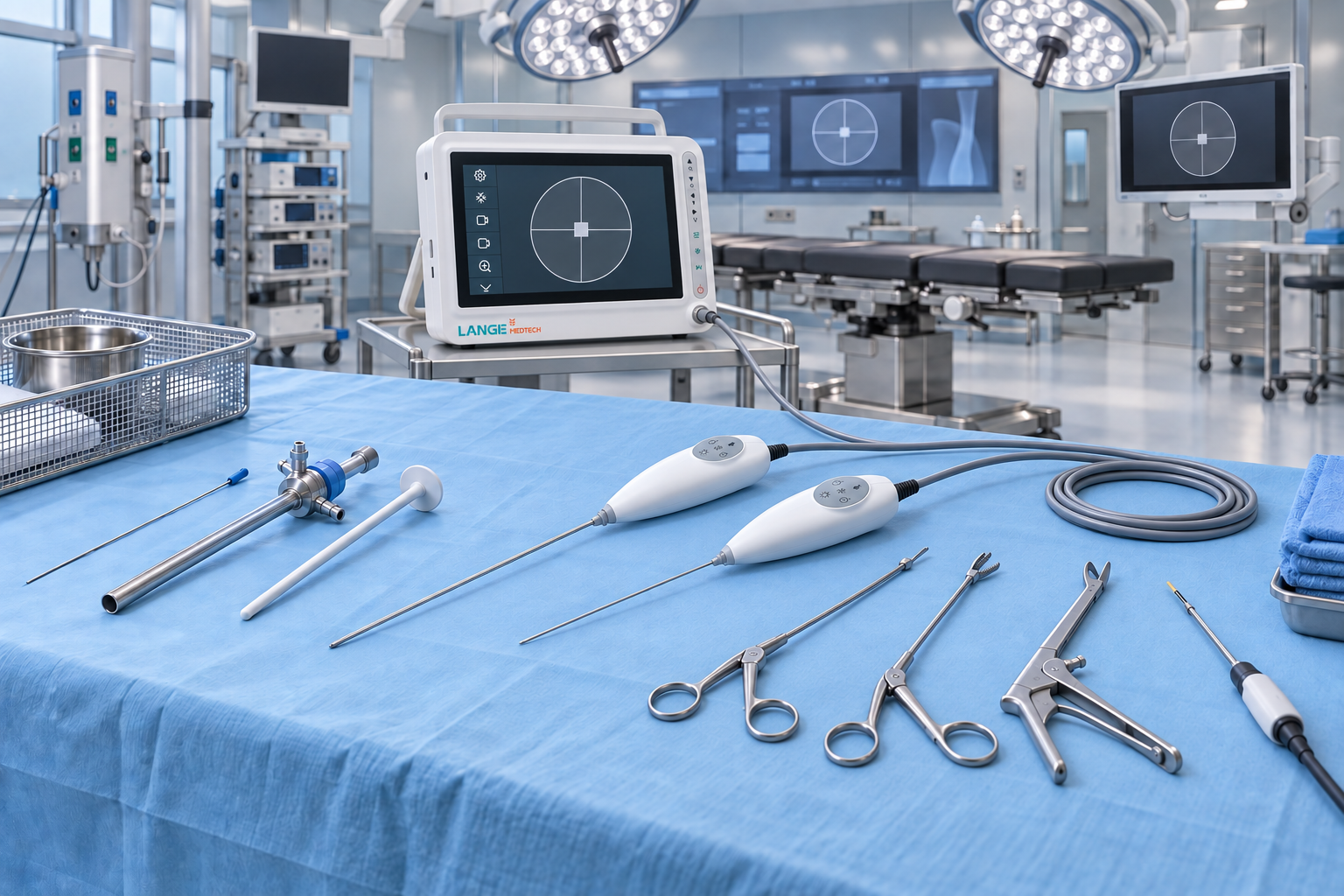
Single-use orthopaedic endoscopy cannot begin only after the scope enters. Where an instrument portal is needed, safe entry, maintained access, soft-tissue protection and fluid management make observation and treatment possible. Needles, guidewires, dilators, obturators, cannulas and valves may perform these tasks. Arthrex's sterile access kits illustrate that access tools are themselves a definable, deliverable product unit.
What is necessary is reliable access, not making every access tool disposable in every orthopaedic procedure. Entry techniques vary, and tools must be chosen according to authorised uses and instructions. Single-use options may improve preparation, availability and consistency of sharpness; reusable options may be economical with mature reprocessing and high utilisation. Actual data are needed. Single use alone does not establish a lower infection risk.
Product specifications should state scope diameter, access dimensions including the sheath, and therapeutic-instrument dimensions together. A 2 mm viewing scope does not mean the entire procedure can be performed through 2 mm. Deep hip access, narrow foot-and-ankle spaces and UBE differ in required access length, stability, irrigation and instrument exchange. Access tools and interfaces must be evaluated with the scope to determine whether the intended task can be completed.
Single-Use Treatment Instruments Exist, but Fit Still Matters
Observation is only the beginning; treatment needs grasping, biting, cutting and tissue management. Single-use graspers, biters and scissors appear in Arthrex's Nano range, and TeDan offers sterile single-use Kerrison rongeurs. This is not entirely a future concept. Yet the existence of a conventional spinal Kerrison does not prove that it fits through a needle-scope channel. Catalogue bite width is not shaft diameter or a channel-compatibility dimension.
Single use does not mean low mechanical demand. Grasping force, cutting edges, jaw alignment, connection strength and reliability after repeated opening and closing during a procedure still require validation. Suitability for a joint or spinal technique also depends on working length, movement space, the endoscopic view and local registration. Combining instruments from different suppliers does not establish a compatible system.
Energy and powered instruments demonstrate another established architecture: make tissue-contacting, wearing or hard-to-reprocess treatment ends disposable while retaining control and drive functions in reusable equipment. WEREWOLF and COBLATION descriptions include reusable controllers and single-use treatment probes; arthroscopy also has single-use shaver blades and burrs. Blades, handpieces, motors and consoles must be distinguished. A disposable blade does not make the whole powered system disposable.
Radiofrequency and plasma are not wholly separate energy categories. In COBLATION, for example, the plasma process is radiofrequency-mediated. Product terminology must not obscure validation of output, irrigation interaction and thermal safety. A single-use treatment pathway should cover visualisation, grasping and biting, ablation and haemostasis, and shaving and burring according to the task. Select the modules needed for each case rather than opening every consumable.
The Value Lies in Readiness and Delivery
For institutional customers, a product portfolio can combine validated basic access and visualisation with mechanical, energy and powered-treatment modules selected for the procedure. Sterile boundaries, compatibility, fluid paths, traceability and backup arrangements require joint validation. Infrequently used modules should stay separately packaged until needed. The resulting single-use pathway delivers predictable preparation and instrument availability, not merely a larger consumables pack.
ASCs Evaluate the Whole Surgical Workflow
Turnaround Benefits Need Real Cases and Costs
A US ambulatory surgical centre, or ASC, meets specific licensing and service requirements; it is not simply a small operating room. Patient selection, anaesthesia and recovery, infection control, emergency response and transfer capability are operational prerequisites. Medicare ASC facility payments generally include many supply and equipment costs. Single-use systems can therefore be compared for preparation, turnover and reprocessing burden, but ASC use does not automatically bring additional reimbursement or higher profit.
A prospective study published in 2026 compared 60 anterior ankle arthroscopies at two ASCs. The needle-arthroscopy group had faster turnover, but the difference in total cost was not statistically significant. Excluding turnover costs, the conventional group cost less. The result illustrates how instrument value depends on an institution's treatment of time costs; it cannot establish the same economic advantage for every ASC or orthopaedic procedure.
ASC comparisons should include consumables actually opened, preparation and turnover, repair and reprocessing, console utilisation and backup arrangements. Saved time becomes additional capacity only when staff or operating rooms are genuine bottlenecks and patient demand exists. Every minute cannot simply be converted into cash savings and then counted again as new revenue. More predictable instrument cost per case also depends on reliable supply, suitable configurations and a controlled rate of extra scopes being opened.
Day Surgery in Chinese Public Hospitals: Policy and Commercial Conditions
A Clear Policy Direction, with Institutional Pathways Still Developing
In China, a more appropriate starting point is day-surgery units within public hospitals with the required capabilities. The National Health Commission's interim provisions define day care as an inpatient pathway completed within 24 hours and explicitly make it part of inpatient services. Hospital day surgery in China is therefore not directly equivalent to a US ASC. Nor does buying a single-use system permit an ordinary outpatient clinic to perform operations outside its authorised scope.
Policy support has produced observable progress. National monitoring results for 2023, published in 2025, showed that 83.27% of tertiary public hospitals offered day surgery, which accounted for 16.40% of elective operations. The first figure measures institutional coverage; the second measures case mix. They are not contradictory, and neither describes 2026 use of single-use orthopaedic endoscopes.
Orthopaedic day-surgery pathways require coordinated procedure and patient selection, anaesthetic assessment, scheduling, recovery and pain management, discharge criteria, home care and follow-up. The provisions also require a first follow-up within 24 hours after discharge, together with emergency, consultation and referral arrangements. A thinner scope or disposable instruments affect only some preparation and use steps; they cannot replace the full clinical pathway.
For product introduction, choosing suitable procedures in public hospitals with stable case volumes, experienced teams and rescue capability makes it easier to validate safety, turnaround and per-case cost together. This is a commercial assessment based on institutional conditions, not an exclusion of other qualified providers or a market-share forecast.
Insurance Payment and Hospital Purchasing Need the Same Per-Case Account
For basic medical insurance, first check local day-inpatient settlement, case grouping and charging policies. Under DRG/DIP or other case-based payment, hospitals bear the resources consumed by the whole episode within the relevant payment and quality requirements. A more expensive disposable device does not automatically increase revenue. Individual review of exceptional cases offers a route for qualifying complex, high-cost cases and new technologies, but requires hospital application and assessment; it is not guaranteed extra payment for a particular scope.
Settlement between hospitals and insurers, hospital charges to patients, and patients' final reimbursement are related but distinct rules. A procurement award does not authorise a separate charge, and an authorised charge does not imply full reimbursement. Suppliers and hospitals must align registered uses, procurement access, console support, consumable configuration, charging and settlement boundaries before deciding whether lower reprocessing or turnaround costs cover added consumable expense.
Commercial Insurance Supplements Coverage, Not Automatic Payment
There is policy space for supplementary commercial insurance. A 2025 financial-regulator notice on city-based commercial medical insurance called for new medical technologies, drugs and devices to be included in coverage, while stressing market-based operation, reasonable liabilities and sound pricing. For single-use orthopaedic endoscopy, this creates scope to evaluate partnerships around defined clinical needs and cost value. It does not mean every new device or day-surgery procedure is already insured.
Providers and patients still need to check the actual policy: covered hospitals and networks, the definition of day admission, medical necessity, consumable coverage and exclusions, deductibles, reimbursement percentages and limits, and prior authorisation. Coverage may differ between ordinary public-hospital departments, premium services and other institutions. Commercial insurance or transparent self-payment can supplement funding, but cannot bypass clinical authorisation, charging rules or informed consent. Unimplemented insurance partnerships should not be counted as baseline sales.
Policy Support Takes Time to Become Routine Use
Between policy encouragement for day surgery and stable demand for single-use devices lie hospital procedure lists, workflow changes, team training, real-case validation, purchasing budgets and payment coordination. Regions and hospitals start from different positions. A uniform national adoption timetable cannot substitute for these conditions.
Hospitals can first collect safety, turnover and per-case cost data for suitable procedures, then decide whether to expand routine use. Suppliers need to support this with consistent quality, case-appropriate configurations and continuous availability. Insurers likewise need interpretable clinical and claims data before broadening coverage. As policy and commercial conditions mature, an end-to-end single-use pathway may expand. Policy statements or one inexpensive scope cannot achieve the transition alone.
Hospital Cost per Case and Long-Term Manufacturer Capability
A manufacturer's production account cannot replace a hospital's use account. Comparisons between single-use and reusable endoscopes should cover the same procedure type, similar clinical performance and equivalent service conditions. Record actual costs for scope purchase or depreciation, consoles, cleaning and reprocessing, repair, backup and turnaround, extra scopes opened, logistics and disposal.
Single-use systems reduce reprocessing and repair associated with repeated use of the scope, but sterile-supply costs do not disappear: they move into manufacturing and delivery. Reusable systems must include repair and turnaround, not just purchase price. Single-use systems must include underused consoles and extra scopes, not just consumables. Without real use data, neither model should be assumed more economical.
Manufacturers should first establish clinical and safety requirements that cannot be reduced, then check achievable revenue; map the complete functional chain before selecting cost-reduction routes; and measure yield and labour in small batches before expanding investment. In-house production, purchasing and joint development should be compared on lifecycle cost and control, not treated as answers in themselves.
Volume-based procurement provides observable price signals, but it does not choose the architecture, validate manufacturing or make business judgements for the company. A cheaper chip does not necessarily mean a cheaper scope; a cheaper scope does not necessarily mean a lower cost per case. Every link between them needs calculation and verification.
Acceptable cost reduction removes unnecessary complexity, rework and idle resources while preserving clear views, reliable operation and stable delivery. For specific orthopaedic tasks around 2 mm, necessary fibre and precision-assembly costs deserve recognition. Procedures that do not require such miniaturisation should not all pay for the same extreme specifications.
Single use describes how often the instrument is used. What a company must build over time is clinical understanding, product engineering, manufacturing capability, and the ability to deliver dependable access, observation and treatment for a surgical procedure.