
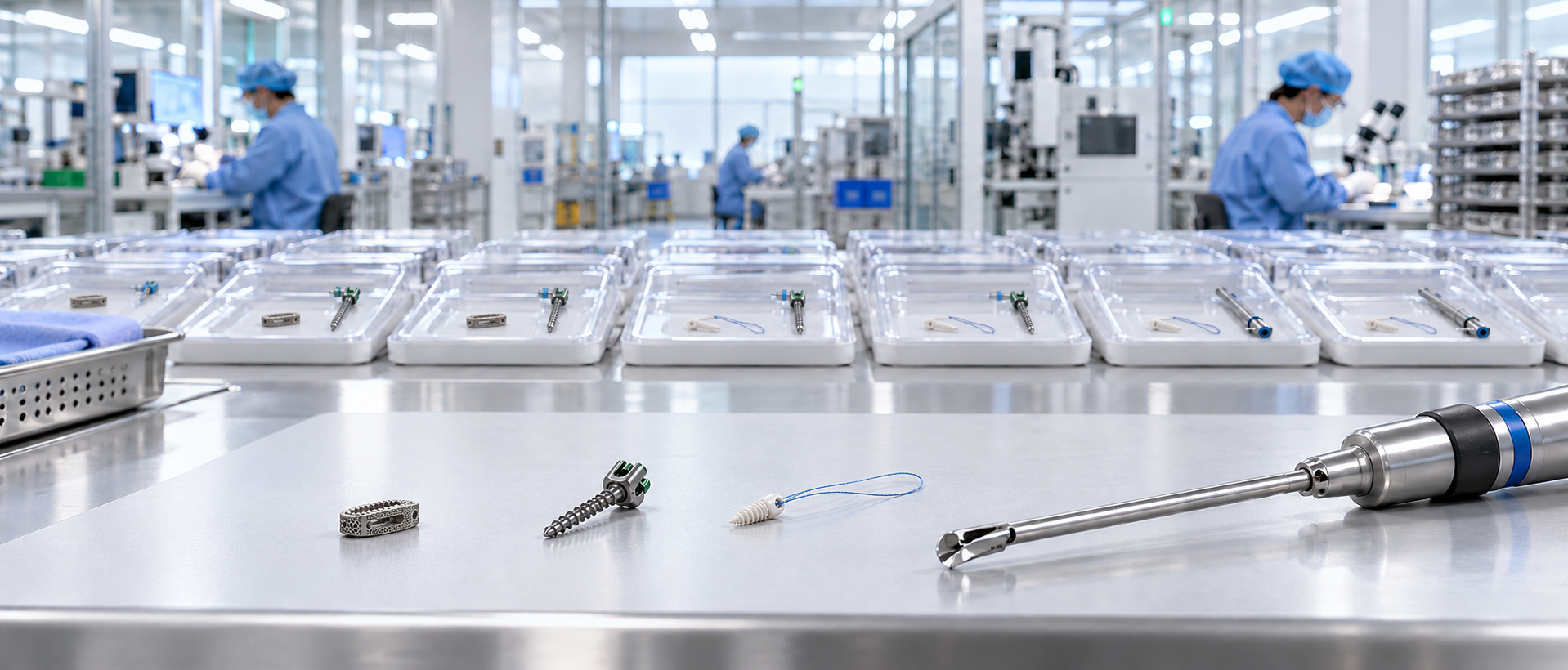
Understanding spine and sports-medicine renewal procurement through product value, operating profit and dependable delivery.
 --views
SI creation: from technology to delivery
Embracing volume-based procurement does not mean calling price cuts good news. It means running the business well after prices have changed. Patients need affordable treatment, clinicians need reliable tools, and companies need earnings to pay today’s wages and fund tomorrow’s research. These accounts have to work together.
Start with prices, then look for opportunity
The first spine tender reduced average procurement prices by 84%; sports medicine saw a 74% reduction. This reset hospital purchasing prices. It put pressure on manufacturers and distributors, but it does not mean manufacturer revenue or gross margins fell by the same percentages: transfer prices, distribution costs, product mix and volume also change.
Average price reductions, not one time series
Average selected procurement-price reduction in each tender
84% and 74% use their respective pre-tender prices; approximately 6% uses first-round selected joint-implant prices. Categories, periods and baselines differ. These are not forecasts for the next tender.
Opportunity should also be measured in results. The 2024 joint-implant renewal involved more than 6,000 hospitals and requested volume of 580,000 sets, with prices about 6% below the first round. In the preceding two years, selected products accounted for over 1.1 million sets and more than 90% of hip and knee implant use. Broad procurement coverage can ease hospital access; it does not guarantee growth for every selected supplier.
Renewal rules also take delivery performance into account. For domestic manufacturers, opportunity is not simply a lower price. It is a closer fit with hospitals through availability, responsiveness and product improvement. That share has to be earned.
Read scope changes against their history
Opportunity becomes concrete at product level, where the rules matter. The 16 October notice concerns product information and corporate relationships, not a complete new tender. Spine should be compared with the 2022 first round; sports medicine with 2023. Wording changes also need comparison with the 30 April 2026 maintenance notice. Mixing these baselines can make an old product look like a new opportunity.
What changed, and what was already there?
Spine: 2022 versus 2026; sports medicine: 2023 versus 2026
| Product | Previously | Current confirmation | Business implication |
|---|---|---|---|
| 3D-printed spine products | Participation was voluntary in 2022. April 2026 included 3D printing, with voluntary participation for customized products. | October includes 3D printing but explicitly excludes customized products. | Check standardized and customized products separately. Being outside this round does not establish unrestricted pricing. |
| Titanium mesh, occipital components, hooks and vertebral-body replacements | Already listed as optional components of relevant systems in 2022. | Named directly in October; not individually named in the April list. | Recheck classification. The wording does not establish first-ever inclusion or separate bidding. |
| Pressure pumps, vertebral expanders and vertebral supports | April did not name pressure pumps separately; metal supports included expansion devices and vertebral supports. | October names pressure pumps and lists vertebral expanders and supports separately. | Map each item to its registration and function. Separate names do not establish separate final purchasing groups. |
| Artificial ligaments and two meniscal-repair categories | The 2023 category table already listed artificial ligaments, meniscal-repair suture consumables and double-needle consumables. | October spells out these three items under soft-tissue reconstruction. | More explicit than April, but not three entirely new procurement categories. |
| Drills, burrs and blades for endoscopic powered systems | The 2023 announcement placed these products under local competitive or price-capped listing arrangements. | October includes them in this confirmation exercise; applicants selling both equipment and matching consumables must maintain basic equipment data. | Prepare compatibility and installed-base records. This does not establish equipment bidding or mandatory bundled sales. |
| Anchors without sutures | Named in the April scope list. | The name is absent in October, without a classification explanation. | Clarify the specific product with the platform; assume neither exclusion nor automatic reassignment. |
These documents concern different stages. Scope wording, component classification and final bidding groups are distinct.
These distinctions change preparation. For standardized 3D-printed products, the manufacturing label alone no longer answers how participation works. Customized products require separate checks of applicable purchasing and payment arrangements. A newly explicit name is not sufficient reason to expand a product line: first establish classification and hospital demand, then assess the investment.

Nor should old rules be projected unchanged into the future. Spine procurement in 2022 used 14 system categories and A, B and C bidding groups; sports medicine in 2023 used product categories and A and B groups. The 16 October notice does not redefine those groups, price ceilings, award criteria or volume allocation. It does not turn corporate-relationship confirmation into delivery qualification either: historical rules concerned control, shareholding and joint filing arrangements. Current details still require the system manual.
Powered endoscopic consumables deserve particular attention. Reviewing equipment and compatible supplies together makes installed base, compatibility, maintenance and continuity of supply a coherent management task. That is a business judgment, not an announced bundled-procurement rule. For technically capable suppliers, the opportunity is dependable long-term hospital use, not merely one more equipment sale.
One market, very different growth
In H1 2026, Double Medical’s spine revenue grew 9.19%, sports medicine grew 72.50%, and joint-implant revenue fell 10.35%. Even within one company, trajectories differ. Sports medicine also starts from a smaller base. Percentage growth is not scale, and procurement alone cannot explain these movements.
Read growth alongside revenue scale
Double Medical · H1 2025 and H1 2026 · RMB million
These selected segments do not sum to company revenue. Revenue growth is not procedure-volume growth. The company’s separate minimally invasive surgery category is not included in spine.
Revenue, attributable net profit excluding non-recurring items, and operating cash flow answer different questions. Both companies below grew revenue, yet their earnings moved differently. A business cannot be judged by its most flattering number.
Revenue, earnings and cash are different
H1 2026 · Consolidated groups · RMB million
| Metric | Double Medical | Sanyou Medical |
|---|---|---|
| Revenue / YoY | 1339.9+10.69% | 274.0+9.71% |
| Attributable net profit excl. non-recurring items / YoY | 278.6+25.10% | 14.2-45.24% |
| Net operating cash flow | 275.6 | 8.0 |
| R&D spending / share of revenue | 167.512.50% | 38.113.90% |
Not a spine-only ranking. Double Medical’s R&D ratio is calculated from disclosed amounts; Sanyou’s is reported. Net profit excluding non-recurring items is not operating profit; cash flow is not earnings.
Sanyou’s earnings decline cannot simply be attributed to procurement. It disclosed about RMB15.61 million of share-based payment expense, alongside impairment and foreign-exchange effects; each requires separate analysis. Both companies continued funding R&D. That is the management challenge: protect innovation while controlling expenses, collections and inventory.
How much extra volume is enough?
Consider an illustrative product priced at RMB100, with RMB50 of variable manufacturing, delivery and other costs, annual volume of 10,000 units and fixed operating costs of RMB300,000. Operating profit is RMB200,000. Cut the price to RMB80 and raise volume by 25%: revenue returns to RMB1 million, but operating profit falls to RMB75,000, a 62.5% decline.
Restored revenue does not restore profit
Illustrative model · Not company results or a pricing recommendation
Operating profit, RMB 10,000; bars start at zero
| Item | Baseline | Lower price, volume restores revenue | Also reduce variable cost per unit |
|---|---|---|---|
| Unit price (RMB) | 100 | 80 | 80 |
| Volume (units) | 10000 | 12500 | 12500 |
| Variable cost per unit (RMB) | 50 | 50 | 40 |
| Revenue (RMB 10,000) | 100 | 100 | 100 |
| Fixed costs (RMB 10,000) | 30 | 30 | 30 |
| Operating profit (RMB 10,000) | 20 | 7.5 | 20 |
Operating profit = (price − variable cost per unit) × volume − fixed costs. Assumes complete operating-cost coverage, sufficient capacity and unchanged fixed costs; excludes interest, income tax and working-capital changes.
With variable cost still at RMB50, volume must rise about 66.7%, not 25%, to preserve the original profit. Alternatively, bringing variable cost down to RMB40 allows 25% volume growth to preserve it. The useful discussion is about reducing scrap, rework, inefficient deliveries and idle instrument capacity, not cutting quality or necessary service.
Fund innovation against specific user needs
Innovation is not just another model number. Limited visibility, difficult access and poor instrument coordination in minimally invasive procedures are problems worth solving. Lange Medtech’s expansion from interventional consumables into endoscopy and navigation, including investments in and integration of ASAP and ErgoSurg, follows that logic. Technology still needs engineering, regulatory work, training and maintenance.
I would reduce each R&D review to four questions: which use problem is solved, by how much, at what additional cost, and will clinicians keep using it? Prototypes need operating metrics; trials need workflow feedback; rollout needs repeat-use and service evidence. Approval is necessary, but it is not commercial validation. Efficiency and clinical claims still require supporting evidence.
Curiosity is compatible with stopping rules. A project with no clear demand, repeated validation failures or persistently uneconomic service costs should be changed or stopped. Reserving scarce resources for questions worth pursuing is part of responsible innovation.
Distribution economics: service and working capital
Manufacturers cannot manage only sell-in, and distributors cannot focus only on the nominal price spread. Slow-moving stock, instrument-set responsibility, urgent delivery and returns all affect earnings. These tasks remain after a price cut and require clear responsibilities and adequate compensation.
Releasing RMB6 million is an operating achievement
Assumes annual credit sales of RMB36m, cost of goods sold of RMB18m and a 360-day year
RMB3m released
RMB3m released
RMB 10,000
Illustration only: uniform credit sales and cost of goods sold; payables and other conditions unchanged. Excludes VAT, seasonality and impairment. Receivables use revenue, inventory uses cost. Cash released is not profit.
That RMB6 million is released working capital, not additional profit. Faster collection and leaner stock require forecasting, reconciliation, returns arrangements and coordinated replenishment, not transferring risk downstream. Nor should inventory reductions create shortages. Working-capital efficiency and on-time, complete delivery must be managed together.

Hospitals buy products and an operating cost structure
Hospital economics extend beyond the purchase price. Preparation, instrument turnaround, maintenance, training and shortages consume resources. Suppliers should demonstrate value with before-and-after records, not just promise an integrated solution: preparation time, downtime and emergency replenishment are measurable. Complications, reinterventions and recovery must also be monitored; efficiency cannot substitute for safety.
A department adopting a minimally invasive technique should define suitable patients, training and supporting resources, then build follow-up evidence. Procurement savings can support training, maintenance and quality management. Companies should likewise fill the capabilities required by their procedures, not manufacture every component merely to claim a complete range.
Make preparation specific to products and hospitals
These principles need accountable, checkable work. Both October confirmations end on the 23rd, but start on different dates. The notice gives no exact closing hour or subsequent tender calendar. Complete the work early; the last day should not be the first day of checking.
What needs to be done now
October 2026 confirmation dates and practical business preparation
| Task | Timing | Work required | Review focus |
|---|---|---|---|
| Product classification | 16–23 October | Regulatory and product teams reconcile registration, reimbursement codes, models and components. Complete missing April maintenance first. | Retain item-level confirmation and unresolved questions; review before submission. |
| Basic equipment data | During product confirmation | Applicants selling endoscopic shaver equipment and matching consumables maintain equipment information in the designated menu. | Internally reconcile compatible models, hospital installations, service and consumable use. These are management preparations, not a claim that all are newly mandatory fields. |
| Corporate relationships | 19–23 October | Maintain relevant corporate relationships under the system manual, reviewed by staff familiar with ownership and application arrangements. | Do not treat this as distributor authorization or delivery-eligibility confirmation. |
| Pricing and supply preparation | Model now; revise when rules are issued | Model contribution, instrument capital, maintenance, stock and collections by product, hospital and service scope. | Keep alternative price and volume scenarios; do not mistake planning assumptions for bidding conclusions. |
The first two tasks concern product confirmation; corporate relationships have a separate start date. Internal review suggestions do not replace the platform manual.
Distributors gain more now by reconciling products in use, installations and service responsibilities with manufacturers than by guessing award prices. Hospitals should check procedural completeness, model interchangeability and fault response. Manufacturers need regulatory, sales, finance and service teams to review product records and pricing models together, before supply commitments reveal uncounted costs.
Keep prices competitive, make products dependable, and deliver the service promised. Reserve part of the savings for the next genuinely useful innovation.