
· Medical Devices · cityboat
Rethinking Bone Cement
Materials science, clinical choices and value in the procurement era

SI creation · The science of powder and liquid
 --views
Powder and a liquid component: after mixing, they thicken and gradually harden. Bone cement can look like one of the simplest orthopaedic consumables. Yet its tasks in a joint and inside a vertebra are different, and products carrying the same high- or low-viscosity label may offer very different handling times. The packaging is simple; the important differences emerge after mixing.
Two questions help explain its development: how can a prosthesis be fixed securely in an irregular bone cavity, and how can a compressed vertebra receive internal support under appropriate treatment conditions? PMMA bone cement evolved around these practical problems. It has enabled important clinical advances while remaining constrained by material properties, operating conditions and indications.
Volume-based procurement now makes brand prices easier to compare. Differences beyond price therefore need clearer explanation. We begin with the history, then viscosity, timing and clinical use, before turning to brands and China's market. My view is that this mature category still has room to develop, but value increasingly depends on reliably meeting clinical needs, not giving an ordinary formulation a more impressive name.
How bone cement entered the operating theatre
This is a history of material technology meeting surgical need. PMMA, polymethyl methacrylate, is an acrylic polymer related to familiar acrylic glass. That family relationship does not make industrial acrylic equivalent to implant-grade bone cement. Purity, formulation, sterilisation, packaging, performance and biocompatibility require dedicated design and evaluation.
By the mid-twentieth century, surgeons could make artificial joint components, but stable fixation in living bone remained difficult. Dental experience with acrylics suggested a material that could fill the gap between implant and bone and cure without external heating. 'Cold curing' describes that processing distinction; it does not mean the reaction generates no heat.
In his retrospective account, D. C. Smith described discussions with John Charnley about cement fixation of femoral prostheses beginning in 1957, followed by experiments and clinical application in 1958. Charnley's preliminary report appeared in 1960; a 1964 paper described experience in 455 cases. These milestones trace a progression from materials research to clinical observation, not the sudden invention of a universal adhesive.
Charnley's contribution went beyond choosing a hardening material: fixation became part of the overall arthroplasty design. Mouldable cement forms an adapting layer between an irregular cavity and a load-bearing prosthesis. Penetration into trabecular spaces followed by curing creates mechanical interlock. It is neither ordinary glue bonding smooth metal to bone nor fixation that must wait for new bone growth.
Commercialisation followed. Heraeus dates the introduction of PALACOS to 1959; its safety and clinical performance summary records commercialisation of a gentamicin-containing predecessor through partners in Germany and Austria from 1972. Antibiotics added a local drug-release function to mechanical fixation. Combining fixation and infection management has remained important, but also makes evaluation more demanding.
From prosthesis fixation to vertebral augmentation
Cement fixation enters clinical joint surgery
Commercialisation and antibiotic products
Percutaneous vertebral augmentation report
Randomised trials and patient selection
Chinese cement procurement
Procurement renewal and updated standards
Spinal use developed later. In 1987, Galibert, Deramond and colleagues reported percutaneous acrylic cement treatment of vertebral haemangioma. That original problem differs from the osteoporotic vertebral compression fractures most often discussed today. Nevertheless, the report clearly documented image-guided percutaneous vertebral augmentation with cement.
Different augmentation techniques subsequently developed. PVP generally means percutaneous vertebroplasty; PKP usually denotes balloon kyphoplasty. Technique, instruments and material jointly shape the procedure, while suitability still depends on the patient's specific condition.
Each important advance began with a concrete problem: fixation, infection risk, access through a smaller channel, or reproducible handling. The same test still works for innovation: first identify the problem solved, then examine the evidence, rather than starting with a 'next-generation' label.
The materials science of powder and liquid
This article primarily concerns acrylic cements for joint fixation and vertebral augmentation, not calcium-phosphate cement, calcium sulphate or other resorbable bone substitutes. PMMA does not set by water hydration like construction cement, nor by solvent evaporation like ordinary glue. After mixing, prepolymerised particles are wetted and swell while liquid monomers undergo free-radical polymerisation, producing a solid containing the original particles and inorganic fillers.
The powder commonly contains prepolymerised PMMA, or copolymers incorporating methyl methacrylate, methyl acrylate or styrene. The PMMA repeating unit is —CH₂—C(CH₃)(COOCH₃)—. Here n denotes repetition, not a small molecule with a fixed molecular weight. Copolymer units modify wetting, swelling, chain entanglement and flow.
Particle-size and molecular-weight distributions, particle shape, copolymer composition, powder-to-liquid ratio and additives jointly determine behaviour. Smaller particles or higher molecular weight may change thickening, but no single factor provides a recipe-independent solution. Identical raw-material names or similar registered ingredients do not establish identical material platforms or clinical working windows.
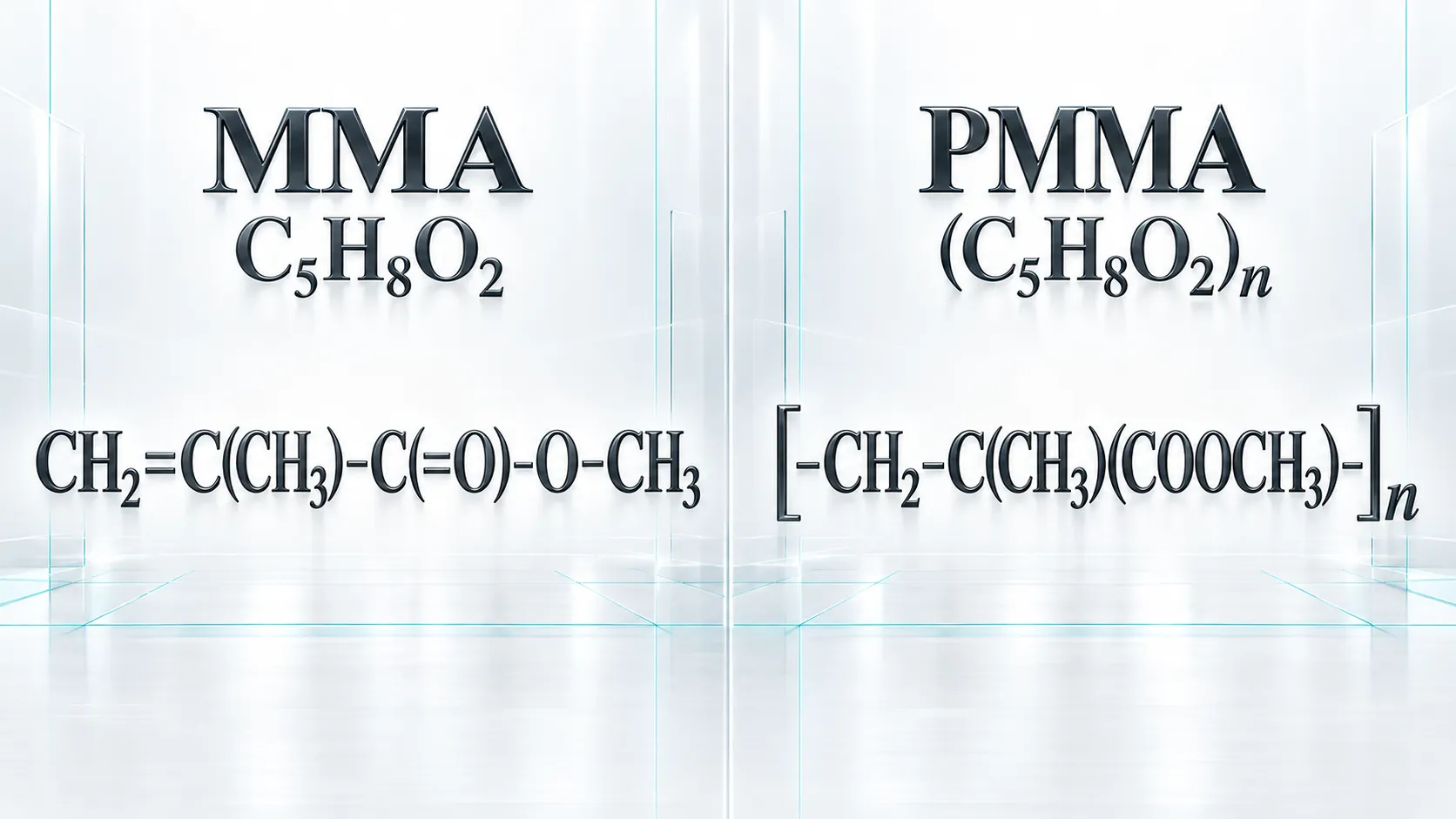
The liquid is usually based on methyl methacrylate, MMA, with formula C₅H₈O₂. It contains a polymerisable carbon–carbon double bond and an ester group. MMA and PMMA differ by one letter but have very different properties: a volatile reactive small molecule versus a polymer. Monomer conversion, residuals and exposure during mixing and curing therefore require attention despite the polymer's long clinical history.
Benzoyl peroxide, BPO (C₁₄H₁₀O₄), usually sits in the powder and contains an O—O peroxide bond. In common room-temperature systems, N,N-dimethyl-p-toluidine, DMPT, in the liquid participates in redox initiation and promotes radical formation, followed by MMA chain growth. 'Accelerator' describes DMPT more accurately than 'hardener': it does not itself harden to fill a bone defect.
Hydroquinone, HQ (C₆H₆O₂), carries two hydroxyl groups in para positions on a benzene ring and commonly acts as an inhibitor for storage stability. Some formulations use a different stabiliser, such as MEHQ; the two are not interchangeable names. Initiation, acceleration and inhibition interact, but this article supplies no formulation recipe. Changing liquid quantities or adding accelerators alters residuals, heat, porosity and mechanical properties together.
Initiation, acceleration and inhibition
C₆H₅–C(=O)–O–O–C(=O)–C₆H₅Initiator
p-CH₃–C₆H₄–N(CH₃)₂Accelerator
p-HO–C₆H₄–OHInhibitor
Minor ingredients can matter greatly. Pigments aid visual assessment; radiopaque particles make cement visible on X-ray; antibiotics enable local drug release. None is an arbitrary accessory: each may affect wetting, rheology, polymerisation, porosity, strength and ageing. Powder-phase percentages, liquid-phase proportions and final mixed composition must be stated separately.
Main components and their roles
| Component | Typical location and identity | Performance questions |
|---|---|---|
| PMMA and copolymers | Prepolymerised particles in the powder | Particle-size and molecular-weight distributions, wetting, swelling and batch consistency |
| MMA | Main liquid constituent; reactive monomer | Conversion, residuals and release, vapour exposure and packaging integrity |
| BPO and DMPT | Powder initiator and liquid accelerator | Reaction kinetics, ageing stability, heat release and handling window |
| HQ and other inhibitors | Storage-stabilising constituents in the liquid | Identity, concentration and stability throughout shelf life |
| ZrO₂ or BaSO₄ | Inorganic radiopaque filler in the powder | Visibility, dispersion, particle interfaces and fatigue performance |
| Antibiotic salts | Drug constituents in approved antibiotic products | Potency, release, biofilm-related evidence, mechanics and resistance risk |
Gentamicin sulphate also deserves precision. It involves gentamicin components and their sulphate salts rather than one chemically identical molecular species. The mass of a drug salt may differ from the stated gentamicin-active dose. Vancomycin hydrochloride and clindamycin hydrochloride have their own structures, stability and release characteristics. Grams of antibiotic alone are therefore not a common efficacy scale across products.
Radiopacifiers: more than visibility
Spinal cement delivery is observed with imaging. Recognising distribution and unintended escape requires sufficient, consistent radiopacity. Zirconium dioxide, ZrO₂, is an established and promising radiopaque material platform. It is a poorly soluble inorganic ceramic dispersed as particles in the polymer, not a molecule dissolved in the liquid.
Its merits must be assessed in the complete product. Public data describe approximately 15% zirconium dioxide in the powder of joint-use PALACOS R+G pro and approximately 45% in a published experimental formulation for Osteopal V. These different sources illustrate different spinal and joint design requirements. They neither prove that more filler is always better nor authorise users to add radiopacifier.
Particle engineering creates further opportunities. Size, agglomeration, surface treatment and bonding to the polymer affect dispersion and crack propagation. Studies on nanoscale and surface-functionalised zirconium and barium particles treat radiopacifiers as deliberately engineered composite phases, not generic white fillers. Such research does not replace fatigue validation or clinical evidence for commercial products.
A 1997 cell co-culture study found greater bone resorption with barium-sulphate particles than zirconium-dioxide particles, although both increased resorption versus controls. Later work with primary human macrophages found no significant differences between the tested cement particles in major inflammatory-factor release. These findings support further research, not claims that zirconia causes no particle reaction or necessarily lowers clinical loosening.
A stronger technical case is that zirconia offers an established high-radiopacity platform with room to optimise the particle–matrix interface. Demonstrating superiority over a barium-containing product still requires matched imaging conditions and comparisons of fatigue, residuals, working time and outcomes. Barium's atomic number is not lower than zirconium's: the argument 'zirconium is heavier, so it must show better' is wrong. Elements, compounds, loading and actual imaging performance are not interchangeable.
Radiopaque fillers: evaluate the whole formulation
Inorganic ceramic particles; dispersion and matrix interfaces matter.
Inorganic solid containing barium ions and sulphate; elemental weight alone does not establish radiopacity.
Different tasks in joints and vertebrae
In cemented arthroplasty, cement lies between implant and bone, providing fixation and load transfer. Long-term performance depends on material, implant design, bone-bed condition and fixation technique. Patients care about stable loading, loosening and revision, not the acronym on a pack. Knowing when the material is suitable for use is part of the surgeon's planned workflow.
Vertebral augmentation requires delivery through a channel and controlled distribution inside the vertebra. Viscosity, channel dimensions, delivery method and local bone structure jointly govern flow. Extrusion in a bench test does not establish safe in-vivo use, and smooth handling with one instrument cannot be transferred to another system without validation.
Two different clinical tasks
An adapting layer between implant and bone
Fixation · Load transferInternal filling and stabilisation in appropriately selected patients
Delivery · Distribution controlTiming also differs. Joint surgery coordinates cement state with implant seating; spinal procedures coordinate material state, imaging and delivery. A working window is therefore not an isolated property inside a packet. It becomes meaningful only in relation to the technique, instruments and team.
Approval of an antibiotic cement for arthroplasty does not establish suitability for vertebral augmentation. Conversely, good spinal injectability does not establish suitability for prosthesis fixation. Even within the PMMA family, each indication needs its own registration scope, design validation and clinical evidence.
Separating spinal and joint cement in procurement thus reflects different clinical tasks, not merely administrative wording. Economic comparison is useful, but the products cannot be treated as the same commodity in different pack sizes.
Why antibiotic cement is more common in joints
Joint replacement introduces a long-term implant, and periprosthetic joint infection, PJI, is difficult to manage. Local drug release from approved fixation cement addresses a clear need. Yet infection prevention in primary arthroplasty, definitive fixation during infection revision, and temporary spacers in staged treatment are distinct uses. They cannot share a blanket claim that antibiotic cement works well.
Release from PMMA depends on accessible surface drug, pores and liquid-diffusion pathways. Early and later release differ, and not all incorporated antibiotic necessarily emerges. Drug identity, salt, particles, formulation, mixing and specimen surface area affect results. Inhibition zones, release concentrations and MIC describe different evidence levels; activity against planktonic bacteria does not establish removal of mature biofilm.
Assessment must therefore integrate pharmacology and material performance. The drug must retain potency through processing and polymerisation, release appropriately and leave a cured body suited to fixation. More porosity may improve release but change strength and fatigue. Broader antimicrobial coverage adds allergy, resistance and exposure questions. Local delivery does not replace systemic prophylaxis, debridement or infection-control pathways.
An international registry study covering about 2.97 million cemented or hybrid primary knee replacements in 2010–2020 reported antibiotic cement use in 77% overall, nearly 100% in Norway and about 31% in the US AJRR. These are practice patterns in specified registry samples, not a ranking of compliance with a universal clinical standard.
Widespread use does not prove added benefit for every primary arthroplasty patient. A 2024 JAMA Network Open cross-registry cohort analysis of about 2.17 million primary knee replacements found no statistically significant difference in one-year revision for PJI between antibiotic and plain cement. This proves neither absolute equivalence nor lack of value in infection revision. Prevention benefits must be discussed by population, procedure, endpoint and evidence level.
Vertebral augmentation has a different incision, implantation environment and risk profile; indication, delivery control and leakage are central. A Korean database study published in 2025 recorded 47 surgical-site infections among 23,868 VP/KP cases, about 0.20%. It examined perioperative systemic antibiotics, not the efficacy of antibiotic cement. A low event rate also means demonstrating incremental benefit from cement-loaded antibiotics requires larger, more rigorous studies.
Spinal antibiotic cement has been studied. A 2019 single-centre, non-randomised prospective kyphoplasty study of 50 patients explored performance and one-year safety. That small open study cannot establish causal infection prevention or justify transferring joint products to vertebrae. Spinal registration and renewed assessment of rheology, radiopacity, delivery, leakage and local safety remain necessary.
China has also recorded approval of a dedicated antibiotic spinal cement: the December 2023 approval list includes registration 20233132048. This shows expanding supply, not a large established market share or proven routine prophylactic benefit. The current instructions remain authoritative for drugs, models and indications.
Read antibiotic-cement evidence by intended use
| Setting | Material task | Essential evidence |
|---|---|---|
| Primary arthroplasty | Permanent fixation and specific prophylactic uses | Infection, revision and adverse events by hip/knee and risk group |
| Infection-related revision | Fixation or temporary spacing alongside infection treatment | Approved indication, debridement and drug pathway, release and mechanical properties |
| Routine vertebral augmentation | Controlled delivery and stabilisation of a fractured vertebra | Spinal indication, incremental clinical benefit and delivery compatibility |
| Spinal infection and other special situations | Individualised specialist treatment | No direct extrapolation from routine augmentation or joint data |
The business implication is straightforward. Joint antibiotic cement has an established usage base; differentiation belongs in fixation quality, drug evidence and workflow. Spinal applications merit research, but joint-use proportions should not simply become spinal sales targets. Chinese developers need registration, pharmaceutical capability and clinical studies on the same development path, not merely an antibacterial claim added to an existing powder.
Viscosity only makes sense along a timeline
Three questions must be separated: a product's viscosity category, its apparent viscosity at a particular moment, and how easily a particular device can deliver it. HV, MV and LV are categories; Pa·s measures viscosity; force is measured in N and pressure in Pa or other pressure units. A pressure reading cannot be renamed viscosity without analysing geometry and flow.
For a Newtonian fluid, viscosity is shear stress divided by shear rate, η=τ/γ̇. Curing cement also depends on reaction time, temperature and shear history, so apparent viscosity ηapp(t,T,γ̇) must be reported under defined conditions. Values for the same product can vary substantially. A universal Pa·s cutoff for 'high viscosity' is not defensible without the applicable document and full test conditions.
The same label can conceal different time curves
Apparent viscosity
Time after mixing
High-viscosity products often develop consistency earlier and may reach a suitable dough state sooner in joint surgery. In spinal use, greater injection viscosity can affect distribution and leakage, but also delivery resistance. Fracture geometry, channel, timing and instrument matter. Less radiographic leakage with one studied product does not prove that all high-viscosity cements are safer or improve every patient's pain and function.
Low-viscosity products commonly have greater early flow or a longer waiting phase, potentially suited to specific narrow channels or arthroplasty workflows. They still thicken during polymerisation. An LV classification does not mean cement should be injected while initially thin. The established spinal product Osteopal V is itself labelled low viscosity: LV is not a synonym for obsolete or inadequate.
Medium viscosity is not half HV mixed with half LV. It is a product choice developed for particular handling and applications, with no universal 'midpoint' curve. Polymer particles, copolymer composition and the complete formulation can create different viscosities from the same principal compounds. Radiopacifier identity does not determine the category either: published experiments describe similar zirconia proportions in PALACOS R and LV despite different handling characteristics.
Comparing viscosity classes professionally
| Dimension | High viscosity (HV) | Medium viscosity (MV) | Low viscosity (LV) |
|---|---|---|---|
| Typical early behaviour | Higher consistency develops earlier | Intermediate handling characteristics depend on the formulation | Generally greater initial flow |
| Joint considerations | Dough formation coordinated with implant placement | Compatibility with coating, pressurisation and instruments | Waiting phase and narrow-nozzle delivery |
| Spinal considerations | Balance of injection-state viscosity and delivery resistance | Validate the rheology–instrument combination | Actual injection state and flow control |
| Does not establish | Necessarily less leakage or a long working time | All advantages of both ends of the range | Necessarily short setting time or low cured strength |
| Procurement classification | Valid registration evidence for the specific model | Same principle; no classification by guesswork | Same principle; extra waiting does not change category |
Timing needs to be decomposed. Mixing is preparation; waiting precedes the intended handling state; dough time marks a defined non-sticking condition in a specified test; working time is the application-appropriate interval; setting time is a method-defined endpoint. Manual arthroplasty, cement-gun and spinal injection windows can differ. A 16-minute setting time never means 16 minutes of continuous injection.
Setting time is not working time
Temperature affects polymerisation and material state, including room temperature, powder/liquid conditioning and contact with mixers and instruments. One room-temperature curve cannot represent every permitted condition. Refrigeration, heating or ratio changes outside manufacturer validation are not routine ways to extend the window. Clinical use follows the instructions; research examines permitted variation under controlled conditions.
Precise instruments do not guarantee correct conclusions. Rheometer gap, roughness, slip, shear rate and loading delay affect results. Storage modulus G′, loss modulus G″ and complex viscosity from oscillatory tests cannot automatically be treated as shear viscosity inside an injection channel. For highly filled, continuously curing materials, these issues belong in the documented method, not only the operator's experience.
Delivery is the other half of the problem. For an ideal Newtonian fluid in a round tube, pressure loss depends on the fourth power of radius. This explains sensitivity to channel size but is not a complete cement model. Non-Newtonian behaviour, connectors, bends, friction and blockage also matter. Inlet pressure is not local vertebral tissue pressure; deliverability and clinically safe control require different validation.
What viscosity-based classification asks of companies
This analysis takes the author's information that products are distinguished as high, medium or low viscosity as its premise. Whether information-maintenance categories become separate bidding units, and which evidence and volume–price rules apply, remain subject to formal documents and platform confirmation. Finer classification first changes data granularity: certificate-level sales may need splitting by viscosity, model, powder weight, antibiotic content and anatomical use.
First establish model-level facts, not a more attractive viscosity label. Registration text, model annexes, technical requirements, instructions and amendments must agree. Several viscosities under one certificate do not justify declaring the whole certificate HV. A shared trademark does not let separate registrants share evidence. Public ingredient lists help understanding, but cannot replace authoritative model identification.
Second, make comparisons reproducible. A common validation plan should define mixing start, environmental and material temperatures, mixing method, shear conditions and delivery device. Evaluate the full viscosity curve, working interval, force at defined times, deliverable quantity, peak exotherm, residuals and mechanics. Variation across batches, shelf-life stages and permitted temperatures says more about delivery capability than one best curve. These are R&D recommendations, not claimed procurement requirements.
Only then model competition. Reconstruct hospital demand by actual model and identify the category demand each product can serve. Simulate separate categories, partial pooling and price linkage. Fewer HV competitors do not guarantee a premium, and an established LV market should not be dismissed for its less striking label. Grouping strategies need real demand, compliant identity and sustainable supply.
Evaluate benefits and risks together
PMMA has endured because it solves genuine fixation and support problems. It conforms to irregular spaces and develops useful mechanical properties after curing. Widespread use does not remove risk; identifiable risk does not remove legitimate clinical value. Assessment belongs to the specific product and conditions of use.
Risk communication needs equal precision. Polymerisation heat, residual monomer and leakage deserve careful evaluation. A laboratory temperature is not automatically the tissue temperature in every operation, and an ingredient hazard is not identical to the clinical risk of a compliant finished device. The question is how risks are validated and controlled for the specified formulation, use and population.
The exotherm of a thick laboratory specimen cannot be assumed to occur in tissue. Volume, geometry, surrounding tissue and heat dissipation all matter. Advertising one extreme number can exaggerate risk; ignoring heat hides a real material property. The validated use range and study conditions are more informative.
Leakage likewise depends on more than flow: local anatomy, fracture morphology and technique matter. HV does not mean zero leakage, and LV is not automatically unsafe. Surgical risk control belongs to the clinical team. Material promotion must not replace imaging judgement or promise 'no leakage' or absolute safety.
Attributing adjacent vertebral fractures solely to cement being 'too hard' is an incomplete explanation. Osteoporosis itself, previous fractures and disease progression affect subsequent fracture risk. Mechanical matching merits research, but changes in laboratory stiffness need clinical evidence before they can explain refracture outcomes.
Antibiotic products require the same comprehensive approach: drug, dose, release, pathogen susceptibility and mechanics must be considered together. Factory-premixed cement and cement with drugs added locally are not simply the same product. Infection-related approval in another country is not automatically a valid Chinese claim or operating instruction.
Vertebral augmentation also has a history of disputed evidence
A story limited to material benefits and immediate postoperative change would be too smooth. In 2009, a randomised sham-controlled study in the New England Journal of Medicine found no clear vertebroplasty advantage in its studied population. Pain improvement requires comparison with natural history, control design and patient selection, not only before-and-after observation.
VAPOUR in 2016 found benefit in a more specifically defined acute, severe-pain population: 120 patients with fractures under six weeks old and pain scores of at least 7/10. At 14 days, 44% in the vertebroplasty group versus 21% in the control group had pain below 4/10. This is neither proof for every osteoporotic fracture nor grounds to dismiss all earlier trials. Selection, disease duration and design change the answer.
NICE recommendations describe recent unhealed fractures with severe continuing pain despite appropriate management, and clinical/imaging confirmation that pain matches the fracture site. These are overseas guidance, not a replacement for Chinese standards. They illustrate why all back pain or every radiographic vertebral deformity cannot be grouped into one indication.
Stabilising a local lesion does not replace continuing treatment of systemic osteoporosis. UK EBI governance advice also emphasises bone health, case discussion and clinical audit. A service ending when surgery ends leaves gaps in risk management. Pain, mobility, bone health and refracture prevention need continuing attention from the appropriate team.
This evidence history matters commercially. Forecasts count packs and expansion plans count hospitals, but patients are not units of sales. Ageing-related need can support appropriate care only if indications and outcome assessment come first, rather than an unlimited pursuit of cement consumption.
Market Shares in China After Centralised Procurement
There is no single bone-cement league table. Joints differ from spine, China from Europe, and revenue shares from pack or weight shares. In particular, the location of a Chinese distributor applying for imported products is not the products' country of manufacture.
The 2022 national spinal procurement offers a rare countrywide demand snapshot. Original documents list first-year spinal-cement demand of 457,938 packs and 10,528,437.5 grams. The following aggregation follows registrant/applicant relationships in that table, using all first-year demand in this category, not the number of all spinal product systems.
2022 spinal-cement declared demand
Demand was concentrated: the five largest entries accounted for 73.30% of packs and 75.08% of weight. Chinese domestic registrants accounted for 29.14% of packs and 27.35% of weight. That registrant-based grouping includes domestic joint ventures; it is neither an indigenous-technology share nor today's localisation rate.
These numbers are first-year declared demand, not final allocated contract quantities or actual sales after implementation in 2023. They reveal the usage base before procurement reform, not a brand's 2026 share. Ranking by packs and by weight also changes some companies' positions.
Our operating estimate for China's full-year 2026 spinal-cement market is approximately 900,000–1,000,000 packs. This is an industry forecast, not officially reported actual procurement.
For sensitivity analysis only, assuming an average end-customer price of RMB 500–600 per pack gives RMB 450–600 million for cement itself. The price is an assumption, not a 2026 weighted transaction average. The estimate excludes balloons, access and delivery tools and is not manufacturer revenue. Variable pack weights and usage per case also prevent converting packs directly into patient counts.
A company's 'share' might mean hospital coverage, surgical use, distributor purchases or recognised revenue. These help explain one another but are not substitutes. Channel stocking can raise quarterly shipments without matching clinical use, while pack-size changes can alter pack counts without proportionate changes in grams or procedures.
I therefore regard 900,000–1,000,000 packs as a starting range for 2026 planning. Companies should test it against end use, inventory and collections. Verifiable national actuals should update the forecast, rather than statistical definitions being changed to preserve an attractive growth story.
International figures need the same limits. A February 2026 British Orthopaedic Association supply notice described Heraeus as supplying 82% of the UK market. That is a particular country's supply position at a particular date, not global or Chinese share. Subsequent supply adjustments also show how availability and validated alternatives influence hospital choices alongside brand experience.
China's joint-cement market is different
Spinal procurement uses packs, whereas the 2023 Beijing–Tianjin–Hebei '3+N' joint-cement procurement used base packs equivalent to 20 grams of powder. A 40-gram commercial pack generally represents two base packs. Boxes, patients, operations and base packs cannot be interchanged. Comparing joint and spinal markets without reconciling units produces misleading size estimates.
The procurement-demand table reproduced publicly by Guosen Securities reports 673,213 first-year base packs: 595,241 antibiotic and 77,972 plain, an antibiotic share of 88.42%. Imported products account for 610,716, or 90.72%, and domestic products 62,497, or 9.28%. This is historical declared demand, not 2026 sales share. The original demand annex was not obtained directly for this analysis, so these figures follow that public compilation.
2023 joint-cement demand structure
The leading applicants were 雷德睦华 with 383,846 base packs (57.02%), Zimmer with 152,272 (22.62%), and Johnson & Johnson with 61,903 (9.20%): together 88.83% using unrounded quantities. Domestic demand mainly involved Jiangsu Lekai (37,392), Beijing Bonsci (23,617) and Shanghai Yijiutai (1,488). Domestic products had entered procurement, but the joint market was more concentrated in international brand systems than spine. Domestic registration does not necessarily mean local ownership or independently developed raw materials.
Demand is not revenue, but it supports transparent price scenarios. Revaluing all historical demand at that round's maximum selected base-pack prices, RMB 260 antibiotic and RMB 200 plain, gives approximately RMB 170 million. Applying a simplified 95%-volume scenario to each category gives roughly RMB 162 million. Without brand/specification weighting, neither number is actual turnover or a 2026 forecast. Pre-reform values cannot describe post-reform markets without separating price from demand changes.
Hunan offers a local reference: 28,598 contracted base packs with an expected total of approximately RMB 7.12 million, or about RMB 249 per base pack. That is a provincial contract mix, not a national uniform price. Antibiotic proportions, specifications, inventory and non-selected purchases differ by region and must remain visible.
Looking toward 2026, joint-cement demand depends on replacement volumes, cemented fixation rates, grams per case, revision mix, antibiotic choice and opened-pack waste. Particularly in hips, biological and cemented fixation differ. Arthroplasty growth cannot be mechanically translated into equal cement growth. Without comparable sales and fixation-method data, identifying these variables is more useful than inventing a precise national share.
A practical opportunity for domestic companies is evidence-based entry into standard hospital workflows: match cement models with implants, mixers and working windows, build long-term follow-up and secure sustainable supply. Turning market authorisation into clinical habit takes time. Registrations and product additions in 2025–2026 show changing supply; the 9.28% recorded in 2023 is not an immutable ceiling.
Brands and regions through international registries
The most useful international comparison is a clinical submarket with a clear denominator, not an unverifiable global revenue ranking. The brand analysis in the registry study used 15 registries providing the relevant detail, excluding the US AJRR. It describes antibiotic cement in primary knee replacement during 2010–2020 by recorded use, not a representative sample of all global cement revenue.
International antibiotic cement use in knee arthroplasty
PALACOS R+G leads this particular antibiotic knee-fixation submarket. Refobacin represents another important product line, while Simplex, CMW and SmartSet also have established use. High viscosity and gentamicin predominated among antibiotic products in the study. This helps explain mature demand in joint fixation, not the product mix that spine should adopt.
Some European registries report almost universal antibiotic use, whereas US AJRR use is much lower. Large registries such as the UK's can heavily influence pooled figures, which should not be read as average national preferences. For international expansion, the target country, primary versus revision surgery, and usual viscosity and antibiotics are more consequential for registration and product portfolios than a claim that the global market is large.
The UK provides a more recent concentration signal. A February 2026 British Orthopaedic Association supply notice stated that Heraeus supplied about 82% of UK bone cement. This is a dated, regional supply statement, not a market audit independently recalculated here. Alongside historical international data it indicates a strong base in some mature joint markets, not a continuous global share-growth curve.
A March 2026 NJR brand summary recorded approximately 1.301 million cumulative knee procedures using PALACOS antibiotic cement. Without a matching all-brand denominator, no share is calculated here. The value lies in long experience and traceable follow-up. A cumulative proportion already revised is not a revision rate with equal follow-up for every case, nor does it establish causal superiority between brands.
International brands combine formulation, instruments, drugs, evidence and supply systems. Heraeus continues to develop viscosity variants, fast-setting and preloaded mixing systems, and has advanced COPAL G+V for specific infection-related uses in the US. Simplex, Refobacin, CMW and SmartSet retain different regional and hospital bases. SYNIMED's public portfolio likewise combines vertebral materials with mixing and delivery equipment. Overseas product families must still be matched individually to Chinese registrations.
The UK's 2026 disruption shows the other side of concentration: healthcare systems need prevalidated alternatives rather than improvised brand substitution. Reliability is part of brand strength, while procurement must manage single-source risk. NHS phased recovery arrangements published in July illustrate supply resilience and clinical switching management, not evidence for dismissing a brand's long-term quality.
A Look at Lange Medical Group's Bone Cement Portfolio
We normalised the 13 awarded spinal-cement entries in the 2022 national procurement results to price per gram. The listed range is approximately RMB 23.50–24.96 per gram. Eurofix is represented by Lange; Shangrong Fanxing belongs to the Lange Medical group.
Price differences on a common per-gram basis
Selected historical specifications and prices per gram
| Registrant / system | Published awarded pack | RMB/g | Like-for-like observation |
|---|---|---|---|
| Ningbo Huake Run | RMB 470 / 20 g | 23.50 | Low end of this sample |
| Shanghai Shangrong | RMB 615 / 26 g | 23.65 | About 4.93% below Eurofix per gram |
| Heraeus | RMB 623 / 26 g | 23.96 | RMB 8 above Shangrong for the same 26 g pack |
| Beijing Bonsci / Dezhou Jianjie | Each RMB 496 / 20 g | 24.80 | Two separate registrant records |
| SYNIMED Eurofix | RMB 622 / 25 g | 24.88 | RMB 7 more per pack than Shangrong, with 1 g less |
| Synthes | RMB 647 / 26 g | 24.88 | Rounded to two decimals |
| Tecres / Shanghai Yijiutai | Each RMB 499 / 20 g | 24.95 | Imported and domestic registrations kept separate |
| Shandong Guanlong | RMB 549 / 22 g | 24.95 | Model numbers must not be read as total powder weight |
Eurofix and Shangrong differ by only RMB 7 per pack, but approximately RMB 1.23 per gram. Using Shangrong as the denominator, Eurofix is about 5.18% higher per gram. That difference alone establishes nothing about quality, outcomes or distributor margins.
First-year 2022 demand was 26,431 packs for SYNIMED and 7,922 for Shangrong, approximately 5.77% and 1.73%. Together that is 34,353 packs, 7.50% of packs and about 8.04% of weight. Combining them is an operating perspective, not a change in their registration identities.
In a sensitivity scenario based on the 900,000–1,000,000-pack 2026 estimate, one percentage point equals 9,000–10,000 packs. At Shangrong's historical RMB 615 per pack, end-customer procurement value would be RMB 5.535–6.15 million; at Eurofix's RMB 622, RMB 5.598–6.22 million. A two-line strategy should reflect hospital handling experience, verified viscosity identity and supply assurance. Imports require authorisation, lead-time and currency management; domestic supply must demonstrate batch consistency, capacity and response. International brand experience and local manufacturing capability can complement each other.
Where further innovation may emerge
Lower modulus, bioactive modification, antimicrobial function and more controllable delivery remain important research directions. Early low-modulus PMMA experiments, for example, altered structure to better match some bone requirements. Modification often changes strength, injectability, monomer release and curing together. Improving one parameter does not automatically preserve the others.
Intelligence needs a defined function. Recording mixing start, indicating validated working stages or generating more interpretable delivery information in an appropriately registered and validated system may reduce variability. But sensor pressure is not pressure at every tissue location, and an estimated state is not a guarantee of tissue safety. Digital information matters only with material and device validation. These are development directions, not claims about an existing product's approved functions.
Minimally invasive development is not simply a thinner needle or smaller incision. Narrower, longer or curved channels change delivery behaviour and resistance. Material and device need joint design; excellent individual components do not automatically form a safe and effective combination. Combination validation can matter as much as component improvement.
Standards are evolving too. The October 2026 edition of ISO 5833 states that its requirements primarily concern cement for orthopaedic prosthesis fixation, not directly spinal-fracture stabilisation, although test methods may be applicable. China's YY 0459—2025 has been issued with implementation scheduled for 1 March 2028. Standard conformity, registered indications and clinical evidence answer different questions and cannot replace one another.
Familiar products still require ongoing evaluation. Compliance is a technical conclusion within a defined scope, not permission for every use. Registration asks what a product may be used for; testing asks how it performs under particular conditions; clinical research asks what happens to particular patients. Keeping these questions distinct prevents innovation becoming an accumulation of concepts.
More concrete value for hospitals and distributors
For hospitals, cement should be more than a procurement line. Switching brands or models requires handling training, mixing and delivery compatibility, batch traceability, inventory turnover and adverse-event feedback. Suppliers and distributors should contribute to this daily work, not appear only at the quotation stage.
Reliable, appropriate care matters more than increasing material consumption. Joint teams need fixation and infection-risk pathways; spinal teams need experience in selection, imaging and safe procedures. Companies can supply accurate information and compliant training but cannot replace clinical decisions.
Product selection benefits from cross-functional agreement: procurement manages the catalogue; clinicians and nurses understand handling differences; stock and batches remain traceable; feedback reaches quality management. Teams may know several compliant models, but an emergency substitution should not become their first encounter with a new product.
From eligibility to sustained use
Indications · Models and compatibility
Team awareness · Authorised training
Inventory expiry · Batch traceability
Follow-up · Quality response
Department development should also look beyond procedure counts. Joint fixation calls for follow-up, complications and revision outcomes; vertebral augmentation calls for selection, pain, function, refracture management and continuing care. Hospital comparisons need adjustment for case mix, not league tables built from unadjusted indicators.
Distributors still create value after procurement reform, but their tasks are specific: checking models and compatibility, managing expiry and stock, responding to reasonable replenishment requests, and passing traceability and complaint information. Training requires appropriate competence and authorisation. Diagnosis and clinical operation remain the medical team's responsibility.
Service should not be an unverifiable catch-all. Fulfilled delivery duties, questions for the manufacturer and substitutions requiring hospital approval should be explicit. Transparent, workable agreements support cooperation better than a vague promise of constant availability. Channel quality is part of a consistent clinical product experience.
Embracing procurement reform means accepting reasonable price constraints while doing clinical and quality work properly. Hospitals need more than a cheaper invoice; companies need more than award status. The product must fit a care system that can keep operating, allowing cost savings and dependable use to coexist.
The value of one pack of bone cement
The first national procurement's spinal-cement prices, where powder weights are stated, normalise to RMB 23.50–24.96 per gram. That is already a narrow brand spread. The more interesting question is what hospitals choose when prices converge, and why surgeons continue using a product.
The answer emerges after mixing. Products labelled HV can differ in when handling becomes suitable, how long it remains suitable and how well they fit existing mixers and delivery equipment. Teams need familiarity with these differences and, above all, consistency between batches of the same model. Relearning every batch burdens the whole operating team. Viscosity classification helps procurement, but does not complete clinical product selection.
International experience deserves serious attention. PALACOS R+G had high use in the cited knee registry study, and NJR holds many related procedure records. These figures do not prove superiority, but show that domestic companies compete with products backed by long experience. After demonstrating technical compliance, a manufacturer must answer how long a product has been used, in whom and with what follow-up. Evidence takes time; starting now is more useful than waiting for the next tender.
Manufacturing has the same time dimension. A good laboratory batch must become continuous reliable production. Do new raw-material lots, variation in particle size or late shelf-life change handling beyond the validated range? Routine production and inspection must answer this. Batch consistency is essential if clinicians are to switch confidently to domestic cement.
For minimally invasive and intelligent systems, I care about the step actually improved: compatible delivery through a curved channel, fewer mixing differences, or validated state indicators that help teams manage time. A screen or pressure number alone proves little. Developers need combination-use validation, showing clinicians what information can support decisions and what still depends on imaging and experience.
Someone must explain those differences before a hospital changes products. Cement without the matching instruments, or a new working time discovered just before surgery, creates avoidable problems. Forecasting hospital demand, stocking suitable sizes and arranging manufacturer training all cost money. If manufacturers omit those costs, hospitals or distributors usually absorb them. Long-term arthroplasty records and spinal follow-up remain clinical responsibilities that suppliers may support, not replace.
Tender costing often misses small items: packaging losses, reserve stock, delivery frequency and collection periods. Modest amounts per pack accumulate into meaningful annual profit effects. Higher volume also needs inventory and working capital, which should be calculated before bidding. Scale can spread costs; it cannot repair a loss embedded in every pack.
I remain positive about bone cement. Materials research has room to advance, and Chinese companies can combine manufacturing, instruments and local service more effectively. Hospitals will not keep buying because a label says 'domestic innovation', nor will they recognise only imported brands forever. The next procurement round is worth competing for by making products consistent at lower prices, explaining handling differences clearly, and earning the hospital's decision to purchase again.
Domestic registrants and product records
Search cutoff: 24 October 2026.
Domestic registration records
| Registrant | Product / brand / model | Registration number |
|---|---|---|
| 山东明德生物医学工程有限公司 | Bone cement; brand/model unverified | 国械注准20223130916 |
| 山东明德生物医学工程有限公司 | Additional candidate bone-cement record | 国械注准20243130083 |
| 北京邦塞科技有限公司 | Spinal bone cement; model unverified | 国械注准20193130327 |
| 北京邦塞科技有限公司 | Antibiotic spinal bone cement | 国械注准20233132048 |
| 北京邦塞科技有限公司 | Bone cement; model unverified | 国械注准20243131156 |
| 北京邦塞科技有限公司 | Antibiotic joint cement JA-HV / JA-MV | 国械注准20203130530 |
| 北京邦塞科技有限公司 | Joint cement J-HV / J-MV | 国械注准20213130943 |
| 上海尚融生物科技有限公司 | Acrylic resin bone cement II-13 / II-26 | 国械注准20213130800 |
| 上海尚融生物科技有限公司 | Antibiotic bone cement III-40 | 国械注准20233130745 |
| 上海朗迈医疗器械科技有限公司 | Acrylic resin bone cement; brand/model unverified | 国械注准20243132247 |
| 上海意久泰医疗科技有限公司 | Spinal bone cement | 国械注准20203130359 |
| 上海意久泰医疗科技有限公司 | Joint cement ARJ0140 | 国械注准20223130546 |
| 宁波华科润生物科技有限公司 | Bone cement and accessories | 国械注准20223131186 |
| 德州健洁医疗器械有限公司 | Acrylic resin bone cement CLVP | 国械注准20223130328 |
| 德州健洁医疗器械有限公司 | Acrylic resin bone cement CSV1 / CLV3 | 国械注准20233131302 |
| 德州健洁医疗器械有限公司 | Antibiotic bone cement | 国械注准20243131512 |
| 山东冠龙医疗用品有限公司 | Composite bone cement GC20A | 国械注准20213130946 |
| 江苏乐铠生物技术有限公司 | Bone cement; 26 g powder pack | 国械注准20223130866 |
| 江苏乐铠生物技术有限公司 | PALACOS H | 国械注准20223130881 |
| 江苏乐铠生物技术有限公司 | PALACOS HG | 国械注准20223130864 |
| 江苏乐铠生物技术有限公司 | PALACOS MG | 国械注准20223130966 |
| 江苏乐铠生物技术有限公司 | PALACOS LG | 国械注准20223130968 |
| 大博医疗科技股份有限公司 | Additional candidate bone-cement record | 国械注准20253132610 |
| 深圳市中科海世御生物科技有限公司 | Additional candidate bone-cement record | 国械注准20263130264 |
| 郑州捷正实业有限公司 | Additional candidate bone-cement record | 国械注准20263131515 |